Magnetic Attachment Explained: Why Magnets Make Wireless Charging Better
Learn how magnetic attachment fixed alignment, unlocked faster 15W Qi2 charging, and became a foundation for the next generation of wireless power.
Magnetic Attachment Explained: Why Magnets Make Wireless Charging Better
On the surface, magnetic attachment looks like a small feature — a few magnets that help your phone click neatly onto a charger. In reality, it solved the single biggest weakness of early wireless charging and unlocked faster speeds that had not been possible before. Here is why a handful of tiny magnets turned out to be a big deal.
The Problem Magnets Solve
Wireless charging works through magnetic induction: a transmitter coil in the charger creates a changing magnetic field, and a receiver coil in the device converts it back into power. This transfer depends on the two coils being reasonably well aligned. In the early days, that was left to the user — and users are not precise. Set a phone down a little off-centre and the connection could weaken or fail, leaving you with a slow charge or none at all. The fix was not more power; it was better positioning.
How Magnetic Alignment Works
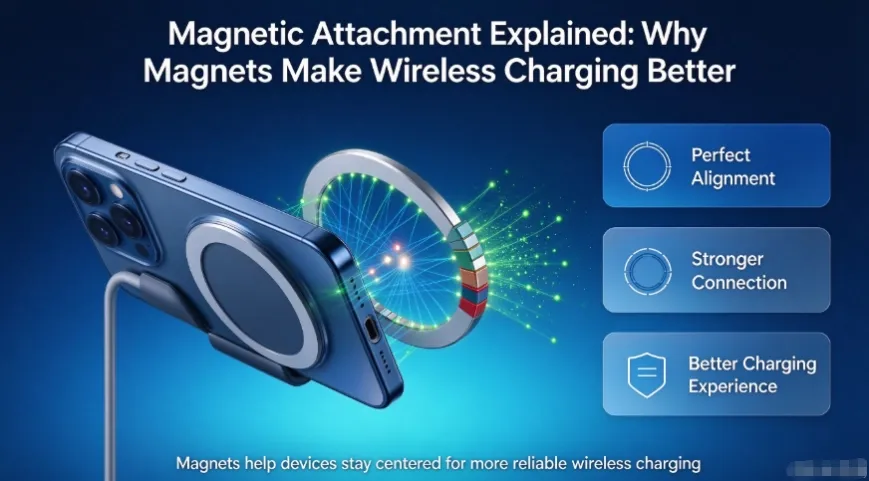
Magnetic attachment solves positioning by design rather than by luck. Magnets built into the device and the charger pull the two together and hold them in the exact spot the coils need. Instead of nudging your phone around and watching for a charging light, you simply bring it close and let the magnet do the rest. The result is a connection that is consistent every time, no matter how rushed you are.
Why Alignment Unlocks Speed
Good alignment is not only about convenience; it is a precondition for speed. Higher power levels demand a stable connection, because a coil that drifts out of place cannot transfer energy efficiently. When Qi v2.0 introduced magnetic attachment in 2023, it also enabled a faster 15W charging level. The two advances were linked: by guaranteeing alignment, the standard could safely raise the power. That combination is why Qi2 felt like a genuine upgrade rather than a small tweak — and why it went on to reach more than 1.5 billion devices within its first year.
Where You See It
The most visible example is the phone that snaps onto a charging puck or stand. But the same idea extends further. The WPC's roadmap includes accessories that attach magnetically to the back of a phone, using that secure hold as the basis for both power and physical connection. Magnetic attachment is becoming a general-purpose interface, not just a charging technique.
A Standard, Not a Gimmick
It would be easy to dismiss magnets as a neat trick, but they sit inside a rigorous framework. Products that use the relevant profiles must pass testing at independent, authorised laboratories, and the Qi 1.3 and 2.0 specifications require Extended Power Profile (EPP) and Magnetic Power Profile (MPP) chargers to carry a public key certificate as part of a PKI authentication scheme. Only Qi-certified products may bear the Qi or Qi2 logo, and only WPC members may apply for certification. In other words, the magnet on your charger is backed by the same safety, efficiency and interoperability principles that have guided the standard since the beginning.
Everyday Benefits Beyond Speed
Magnetic attachment also has quieter advantages. Because the device stays in one place, charging is more predictable, and a steady connection tends to be more efficient than a struggling one. And by making wireless charging more dependable, the technology encourages people to rely on it — which brings a longer-term benefit: fewer cables to wear out and less mechanical stress on charging ports, a small but real contribution to reducing electronic waste. For devices like AR/VR headsets, a secure magnetic link may be the difference between a feature that works smoothly and one that frustrates.
The Road Ahead
Magnets helped make wireless charging fast, and the trend continues. Qi2 25W, released in July 2025 as Qi v2.2.1, delivers nearly 70% more power than the original Qi2 and can charge a phone from 0 to 50% in about 30 minutes — speed that rests squarely on the alignment foundation magnets provided. As standards evolve toward even higher power, magnetic attachment is likely to remain the quiet enabler that makes it all work.
FAQ
Do the magnets interfere with the phone? Magnetic attachment is designed into the standard for exactly this purpose, and certified products are tested for safety and interoperability before they can display the logo.
Is magnetic attachment only for charging? No. It also serves as a secure physical connection, which is why the standard covers magnetically attached accessories.
Does it work through a case? Performance depends on the case, but magnetic alignment is specifically intended to make positioning reliable. A Qi2-certified charger and a compatible device are designed to work together.
Facts sourced from the Wireless Power Consortium.