Oct 9, 2026
The History of Wireless Charging: From Tesla's Dream to Qi2
From Nikola Tesla's early vision to the Qi standard and Qi2 25W — a short history of how wireless charging became an everyday technology.
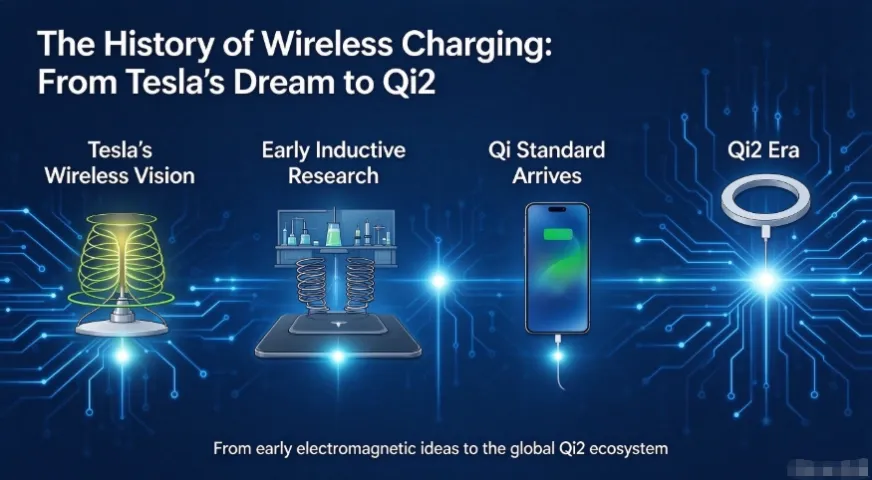
The idea of sending electricity through the air is older than most people assume. Long before the first smartphone was ever placed on a charging pad, inventors were already dreaming of a world without power cords. The story of wireless charging is a story of patience — of an idea that took a very long time to become something you could buy in a shop.
A Century-Old Idea
More than a century ago, the possibility of moving energy without wires captured the imagination of inventors. The most famous was Nikola Tesla, whose experiments with coils and resonance made him the emblem of wireless power. Tesla's ambition was grand — he imagined delivering power across distance — but the tools and materials of his era could not make it practical. The dream was real; the technology was not yet ready.
The Vision Meets the Physics
The principle Tesla and others worked with is the same one that powers today's chargers: magnetic induction. A coil carrying an alternating current creates a changing magnetic field, and a second coil placed nearby can be made to carry an induced current. The physics has always worked. What was missing was everything else — efficient electronics, precise manufacturing, and a shared set of rules that would let devices from different companies talk to one another.
From Invention to Standard
That last piece — shared rules — is what transformed a laboratory curiosity into an everyday product. The Wireless Power Consortium (WPC) took on the task of building those rules, guided by three enduring principles: safety, efficiency and interoperability. Its standard, Qi, was first published in 2010. For the first time, wireless charging had a common language, and any certified device could be expected to work with any certified charger.
2010: Qi Arrives
Qi's arrival marked the beginning of the modern era. Chargers and phones could finally be certified against a single specification, and the familiar logo became a promise that a device had passed independent testing. Over the years that followed, the ecosystem grew steadily, and today more than 13,000 Qi-certified products have reached the market. Qi spread beyond phones as well: WPC members have installed Qi-certified chargers in thousands of restaurants, hotels, cafés, public transport and other public places around the world.
The Magnetic Turn: Qi2
Early wireless charging had a well-known weakness: alignment. If the coils did not line up well, charging slowed. Qi v2.0, released in 2023, addressed this by introducing magnetic attachment. Magnets pull the device into the ideal position, so the connection is secure and consistent, and the improved alignment made faster 15W charging possible. The response was immediate and global — in its first year, Qi2 reached more than 1.5 billion devices.
2025: Qi2 25W
The most recent chapter came in July 2025 with Qi2 25W, formally Qi v2.2.1. It lifted power by nearly 70% over the original Qi2, enough to charge a phone battery from 0 to 50% in about 30 minutes. Development of an even more ambitious Qi2 50W proposal has drawn experts from technology companies around the world, including meetings held in Beijing — a sign that momentum in the field continues to build.
More Than Phones
The roadmap now reaches well beyond smartphones. The standard is being shaped to support AR/VR headsets and accessories that attach magnetically to the back of a phone, while a separate WPC effort known as Ki targets cordless kitchens. Meanwhile, the WPC continues to concentrate on near-field charging; far-field power over distance remains limited by cost, efficiency and safety considerations.
Why the Timeline Matters
The history of wireless charging is not just trivia. It explains why the technology feels dependable today: decades of work went into the standards, the certification process and the safety checks that make a simple pad reliable. When a product carries the Qi or Qi2 logo, it is the latest link in a chain that stretches back more than a century.
FAQ
Who invented wireless charging?
No single person did. Nikola Tesla popularised the dream of wireless power, but the modern standard was built collaboratively by the Wireless Power Consortium and its members.
When did Qi start?
Qi was first published by the WPC in 2010.
What is the newest version?
Qi2 25W, or Qi v2.2.1, was released in July 2025.
Facts sourced from the Wireless Power Consortium.