Oct 9, 2026
Qi Authentication and Security: How PKI Keeps Wireless Charging Safe
How does Qi keep wireless charging safe? Learn how PKI certificates authenticate certified chargers and devices in the Qi and Ki standards.
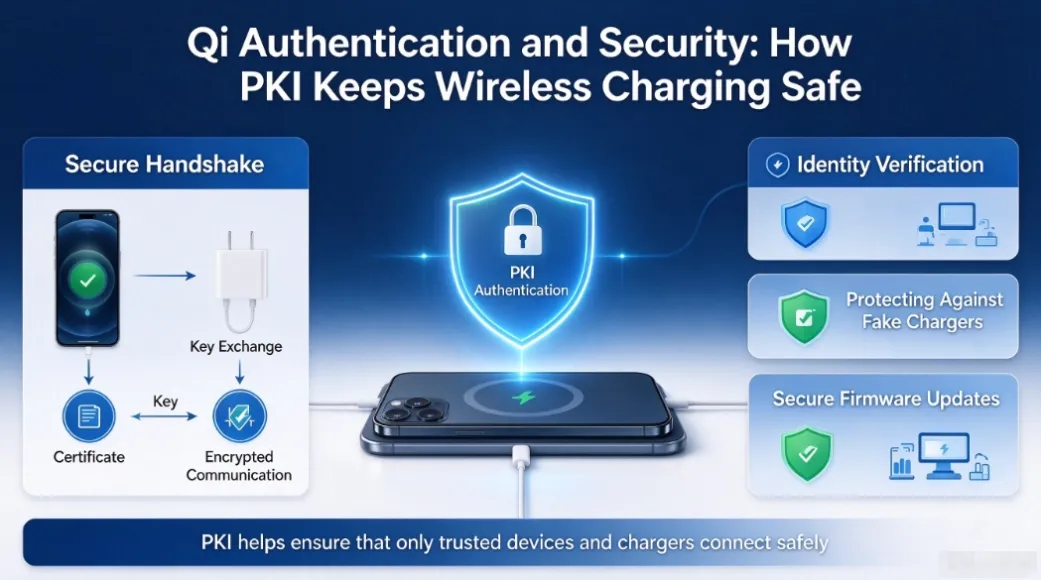
Safety in wireless charging is not only about heat and alignment — it is also about trust. A charger should be able to confirm that it is dealing with a legitimate, tested device, and a device should be able to trust the pad it sits on. That mutual confidence is enforced through authentication, and the Qi standard uses a public key infrastructure (PKI) to make it work. This article explains what PKI does in wireless charging, why the Wireless Power Consortium (WPC) added it, and how it connects to the certification marks you see on real products.
Why authentication matters in wireless charging
As wireless charging grew, so did the incentive to build cheap pads that imitate the real thing without meeting the standard's requirements. Unverified products can behave unpredictably, which undercuts the three values the WPC built Qi around: safety, efficiency and interoperability. Authentication addresses this by giving certified hardware a way to prove its identity. When a charger and a device can verify each other, the system can ensure that the negotiated behavior — including higher power levels — happens only between trusted, tested components rather than across any pad that happens to fit.
What PKI actually is, in plain terms
Public key infrastructure is a system for proving identity using digital certificates. A trusted authority issues credentials, and parties use them to confirm that a product is genuinely what it claims to be. Applied to wireless charging, PKI lets a charger and a device establish trust before proceeding. The key detail for Qi is that the standards themselves require this. The Qi 1.3 and Qi 2.0 specifications call for Extended Power Profile (EPP) and Magnetic Power Profile (MPP) chargers to include a public key certificate. In other words, authentication is not a bolt-on feature — it is written into the specification, and the WPC maintains the relevant Qi and Ki PKI infrastructure that underpins it.
Trust is built into certification
PKI does not operate in isolation; it is the cryptographic layer on top of a testing process that already filters the market. Only products that pass testing are allowed to display the Qi or Qi2 logo. Testing is carried out by independent authorized test labs, and only WPC members can apply for certification. Interoperability Testing Centers add another check by confirming that products work with the broader range of certified devices. As of 2026, the average certification timeline is about 24 days. Authentication then extends that trust into the moment of use: a certificate is evidence that a product passed through the ecosystem's controls rather than merely resembling it.
How this supports high-power charging
Authentication becomes more important as power rises. Qi has progressed from its 2010 launch to an ecosystem of more than 13,000 certified products. Qi v2.0, introduced in 2023, brought magnetic attachment and 15W, and was adopted across more than 1.5 billion devices in its first year. Qi2 25W, released as specification version Qi v2.2.1 in July 2025, increased power by nearly 70% over the first Qi2 generation and can charge a device from 0 to 50% in roughly 30 minutes. The higher the power, the more a charger must be certain it is working with a compliant device. PKI-backed authentication helps ensure that these elevated power profiles are reserved for trusted, tested hardware.
One trust model across Qi and Ki
The same security thinking is being carried into new categories. A related standard, Ki, applies the approach to cordless kitchens, and the WPC's certificate infrastructure is shared across Qi and Ki as Qi/Ki PKI. Beyond kitchens, wireless charging is expanding into AR/VR headsets and magnetic accessories, each of which benefits from a common way to verify trusted components. And because public charging is growing — with WPC members having installed Qi-certified chargers in thousands of restaurants, hotels, public transport and coffee shops worldwide — a shared authentication model matters even more, since users rely on hardware they did not buy and cannot inspect.
What this means for buyers
For everyday users, the practical takeaway is simple. Authentication is invisible when it works, but it depends on the ecosystem staying disciplined. Choosing products that carry the Qi or Qi2 logo means choosing hardware that has passed independent testing and participates in the trust model, including the certificate requirements in the Qi 1.3 and Qi 2.0 specifications. In a category where you often cannot see what is inside the pad, the certification mark and the PKI behind it are the most reliable signals of quality.
FAQ
What does PKI mean in wireless charging?It is a certificate-based system that lets a charger and device prove their identity to each other. The Qi 1.3 and Qi 2.0 specs require EPP and MPP chargers to include a public key certificate.
Do I need to do anything to enable Qi authentication?No. Authentication works behind the scenes. Your main choice is to use products that carry the Qi or Qi2 logo, which indicates certified hardware.
Is Qi authentication the same as Wi-Fi or app security?No. It is specific to the Qi and Ki standards and is maintained by the WPC as Qi/Ki PKI. It focuses on verifying charging hardware, not on your phone's apps or network.
Facts sourced from the Wireless Power Consortium.