Oct 9, 2026
Near-Field vs Far-Field Wireless Power: Why Qi Chose Proximity
Near-field or far-field? Learn why Qi uses proximity-based transfer, how the two approaches differ, and what limits long-distance wireless power.
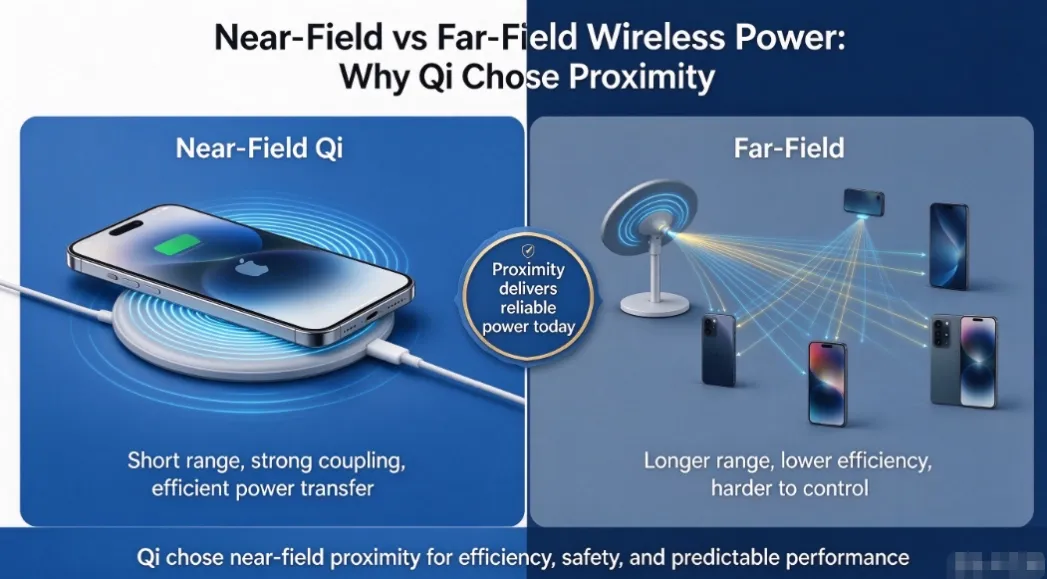
"Wireless power" is a broad phrase, and it hides an important split. There are two fundamentally different ways to move energy through the air: near-field methods, where the transmitter and receiver are close together, and far-field methods, which aim to send power across a distance. The Wireless Power Consortium (WPC), the organization behind the Qi standard, has deliberately built around the near-field approach. This article explains both, compares them fairly, and shows why proximity was the right choice for the charging people actually use every day.
Defining the two approaches
Near-field wireless power transfers energy over a short distance, with the transmitter and receiver close together and generally aligned. Qi is a near-field technology: alternating current in a transmitter coil creates an alternating magnetic field, and that field induces a current in a receiver coil in the device. Because the coils must be near one another for the coupling to work well, the design inherently favors proximity.
Far-field wireless power, by contrast, is intended to deliver energy over longer distances, where the transmitter and receiver are not necessarily adjacent. This is a very different engineering problem, and it comes with very different constraints.
How near-field transfer actually works
The mechanism behind Qi is magnetic induction. A charger's transmitter coil generates a magnetic field when driven by alternating current; a receiver coil inside the device sits within that field and has a current induced in it. The closer and better aligned the coils are, the more effective the transfer. This is why the ecosystem has invested so heavily in alignment: Qi v2.0, introduced in 2023, added magnetic attachment to guide devices into the correct position, and it reached more than 1.5 billion devices in its first year. Good proximity and alignment keep transfer efficient and reliable, and they are also why safety is easier to manage — the field is concentrated in a small, controlled space.
Why far-field is harder than it sounds
It is tempting to assume far-field power is simply "the same thing, but farther." In practice, sending meaningful power across distance introduces obstacles in cost, efficiency and safety. Energy spreads out as it travels, so less of it arrives at the receiver, and the hardware needed to manage that loss tends to be more expensive. Delivering power over open space also raises safety questions that are much easier to answer when the transfer happens inches away rather than across a room. These constraints are exactly why far-field wireless power remains limited in commercial application, and why the WPC continues to concentrate on near-field solutions rather than promising charging at a distance.
The trade-off in plain terms
Near-field wins on efficiency, safety and cost precisely because it accepts a constraint — short range — and optimizes everything else around it. Far-field promises freedom from proximity but pays for it with lower delivered power, higher complexity and harder safety questions. For the everyday job of topping up a phone, earbuds or wearable, the near-field model is the better fit, and its performance keeps improving within that envelope. Qi2 25W, released as specification version Qi v2.2.1 in July 2025, raised power by nearly 70% over the first generation of Qi2 and can charge a device from 0 to 50% in about 30 minutes — all while staying firmly in the near field.
The standard that proximity made possible
Choosing proximity also made interoperability practical. Qi, first launched by the WPC in 2010, now spans more than 13,000 certified products worldwide. A common near-field design means one charger can serve many devices, which is far harder to guarantee when transfer conditions vary wildly with distance. Certification reinforces this: only products that pass testing may carry the Qi or Qi2 logo, testing is performed by independent authorized test labs, and only WPC members may apply, with roughly a 24-day average timeline as of 2026. Interoperability Testing Centers further verify that chargers work across the range of certified devices.
Near-field power is still expanding
Staying near-field has not limited ambition. The same approach is being applied to AR/VR headsets and magnetic accessories, and a related standard called Ki brings it to cordless kitchens. Deployment is broad as well: WPC members have installed Qi-certified chargers in thousands of restaurants, hotels, public transport and coffee shops around the world. What looks like a limitation — short range — has instead produced a standard that is efficient, safe and interoperable at global scale.
FAQ
Can Qi charge a device from across a room?No. Qi is a near-field technology that requires the transmitter and receiver to be close and aligned. Far-field power remains limited in commercial use.
Why is near-field more efficient?Because the coils are close, the magnetic field couples effectively and less energy is lost. Distance causes energy to spread and dissipate, lowering efficiency.
Is far-field wireless power impossible?Not impossible, but constrained. Cost, efficiency and safety challenges keep far-field applications limited, which is why the WPC focuses on near-field charging.
Facts sourced from the Wireless Power Consortium.