Oct 9, 2026
The Anatomy of a Wireless Charger: Coils, Chips, Magnets, and Shielding
A plain-English tour of what's inside a Qi wireless charger — coils, chips, magnets and shielding — and how they work together to move power.
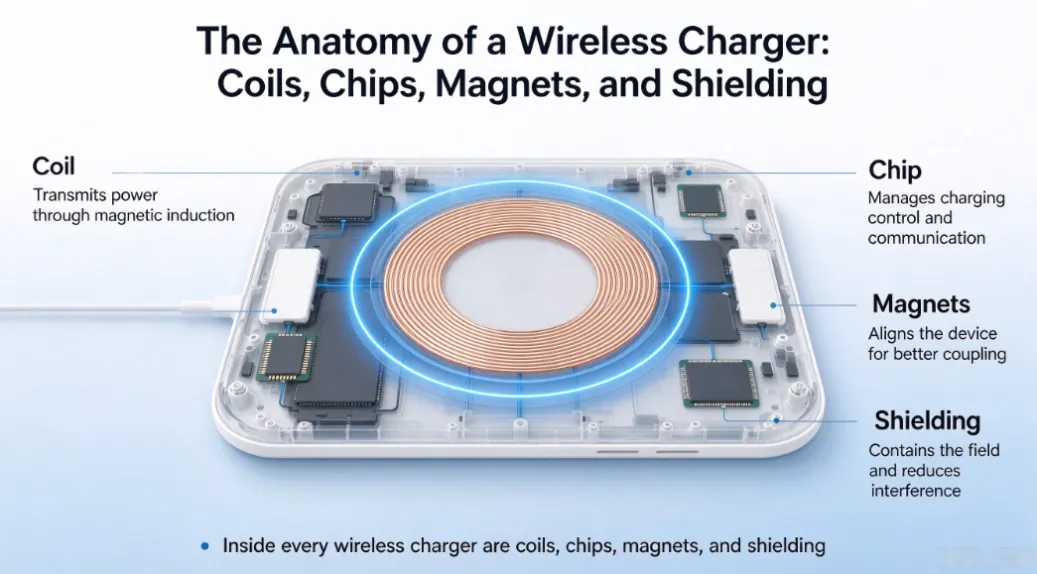
A wireless charging pad looks simple: a flat surface you set a phone on, with no visible moving parts. Inside, though, a small system of components works together to move energy through the air and into a battery. Understanding those parts makes it much easier to see why alignment, power profiles and certification matter so much. Using the Wireless Power Consortium (WPC) as a reference, this article breaks a Qi charger down into its main pieces and explains what each one does.
The coil: where the transfer begins
At the heart of every wireless charger is a coil of wire. The charger side is called the transmitter coil, and the device side is called the receiver coil. The basic physics is magnetic induction: alternating current flowing through the transmitter coil creates an alternating magnetic field, and that field induces a current in the receiver coil inside the device. That induced current is what charges the battery. Because energy only crosses the gap efficiently when the two coils are close and well aligned, the coil is not just a part — it defines the whole near-field approach that Qi relies on.
The chip: the brain of the pad
The second essential component is the control chip, or controller. It manages the flow of power and keeps the transfer within safe and efficient bounds. Rather than simply pushing the maximum current, a Qi charger regulates output based on the conversation it has with the device, adjusting as conditions change. This intelligence is central to one of the WPC's three core values — efficiency — because a smart controller avoids wasted energy, and it is equally central to safety, since the pad must recognize a valid device and behave predictably.
The magnets: alignment made reliable
Anyone who has used an older wireless charger knows the frustration of a phone that charges only when placed just so. Qi v2.0, introduced in 2023, addressed this with magnetic attachment — a set of magnets that physically guides the device into the correct position over the coil. This is not a convenience gimmick; it directly improves efficiency and reliability by ensuring alignment. The feature helped Qi v2.0 reach more than 1.5 billion devices in its first year, and it carried forward into Qi2 25W, released as specification version Qi v2.2.1 in July 2025. That generation lifted power by nearly 70% over the first Qi2 release and can charge from 0 to 50% in roughly 30 minutes, with reliable alignment helping deliver that performance consistently.
Shielding: keeping the field where it belongs
A charger's magnetic field should couple with the receiver coil — not interfere with other electronics or dissipate in unwanted directions. Shielding materials are used to guide and contain the field, protecting nearby components and helping the transfer stay focused and efficient. Shielding is a large part of why a well-designed pad performs consistently and why safety is treated as a first-class property of the overall design rather than an add-on. It also helps explain why certified products are tested so rigorously: the interaction between coils, controller, magnets and shielding has to be tuned as a system.
Power profiles: one pad, many devices
The components above work against a set of agreed power profiles. Qi began when the WPC launched the standard in 2010, and it has grown into a global ecosystem of more than 13,000 certified products. Different devices need different power levels, and the charger's controller negotiates the appropriate profile. Interoperability — the third core value alongside safety and efficiency — is what allows a single certified pad to serve many brands and models. None of that would be reliable if the underlying hardware were not built to specification.
Why certification ties it together
The quality of these components is not left to chance. Only products that pass testing may display the Qi or Qi2 logo, certification is carried out by independent authorized test labs, and only WPC members can apply. The process also includes Interoperability Testing Centers, which check that a charger actually works across the range of certified devices it claims to support. As of 2026, the average certification timeline is about 24 days. For buyers, that logo is a shortcut to knowing that the coils, chips, magnets and shielding have all been evaluated together.
Where the design is heading
The same component set is being adapted to new form factors. Wireless charging now extends to AR/VR headsets and magnetic accessories, and a related standard called Ki applies the approach to cordless kitchens, where the coil-and-controller architecture meets the demands of higher-power cooking appliances. Public deployment is expanding too, with WPC members having installed Qi-certified chargers in thousands of restaurants, hotels, public transport and coffee shops worldwide. In each case, the fundamentals stay the same: a coil to couple the field, a chip to control it, magnets to align it, and shielding to contain it.
FAQ
What is the most important part of a wireless charger?All four main parts matter, but the coil and the controller do the core work — one transfers energy, the other regulates it. Magnets and shielding support alignment and containment.
Do magnets inside the charger affect my phone?Magnetic attachment in Qi v2.0 is designed to align the device over the coil. Certified products are tested to work as intended with compatible devices.
Why does alignment change charging speed?Because transfer works through magnetic induction, better alignment means better coupling and more efficient power transfer, which supports higher and more consistent charging rates.
Facts sourced from the Wireless Power Consortium.