Oct 9, 2026
Wireless Charging and Sustainability: Cutting Cables and E-Waste
How wireless charging reduces cable wear, cuts mechanical stress and helps shrink e-waste — an accessible look at Qi's sustainability story.
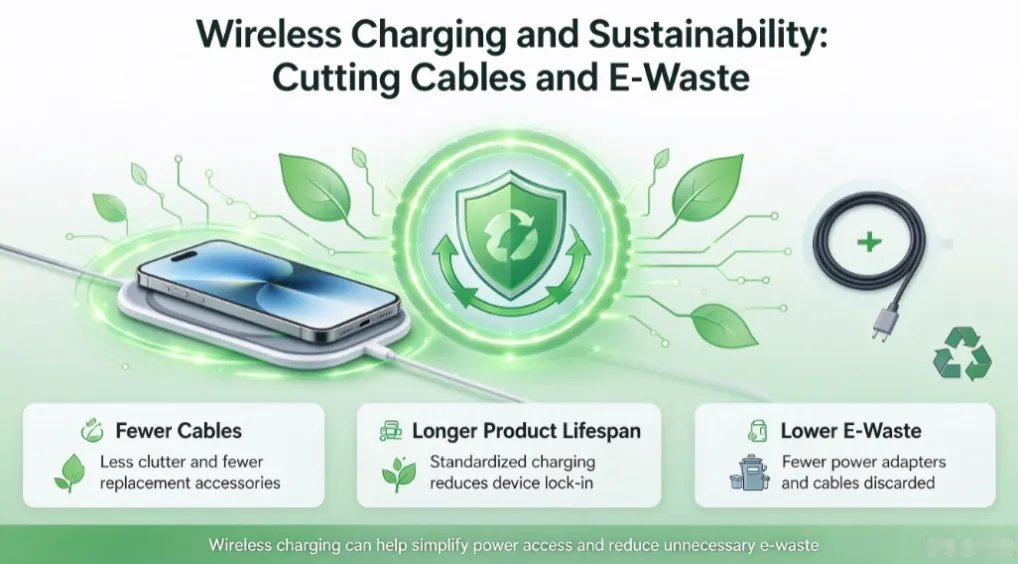
Sustainability has become a central question for every technology category, and wireless charging is no exception. The phrase "cutting the cord" usually refers to convenience, but there is a quieter environmental argument underneath it: fewer cables and connectors mean less physical wear, fewer replacements, and less electronic waste. Drawing on information from the Wireless Power Consortium (WPC), this article explains where the sustainability benefits of Qi-based wireless charging actually come from — and where the honest limits lie.
The wear-and-tear problem with cables
Every wired connection depends on a physical interface: a plug sliding into a port, pins making contact, a cable flexing at the joint. Over thousands of charge cycles, these points of contact degrade. Connectors loosen, ports fill with debris, and cables fray. When that happens, the whole cable — or in the worst case the device — is discarded. Wireless charging removes that mechanical interface entirely. Energy moves through magnetic induction rather than metal-on-metal contact, so there is no plug to wear out and no port to stress. The result is less cable churn and fewer connection-related failures that otherwise send otherwise-working hardware to the recycling bin.
E-waste is a design problem, not just a disposal problem
Electronic waste is often framed as a recycling challenge, but the bigger lever is designing products that last longer and need fewer consumable add-ons. Wireless charging contributes on both fronts. Because there is no cable to wear out, users replace fewer accessories over a device's life. And because charging happens through a sealed surface, manufacturers are less constrained by the need for an exposed, debris-prone port. Durable design and reduced consumable turnover translate directly into less material entering the waste stream.
Battery longevity is an environmental win
Perhaps the most underrated sustainability benefit is battery health. A battery that lasts longer delays the moment a device must be replaced — and device replacement is where the largest environmental costs sit. Wireless charging makes it easy to keep a battery in a healthy middle range. Information cited by the WPC notes that keeping the depth of discharge at about 50% instead of 100% can extend battery life by roughly four times. Frequent, small top-ups on a desk or nightstand naturally encourage this pattern. Better battery habits mean fewer early replacements and, over time, less raw material consumed.
Efficiency: the honest picture
Any discussion of sustainability should avoid overselling. Energy efficiency matters, and it is one of the three core values the WPC built the Qi standard around, alongside safety and interoperability. Qi works through magnetic induction: alternating current in a transmitter coil generates an alternating magnetic field, which in turn induces a current in the receiver coil inside the device. Because this transfer depends on proximity and alignment, the standard has invested in alignment technologies such as the magnetic attachment introduced with Qi v2.0 in 2023. Good alignment keeps energy transfer efficient, which is why the ecosystem emphasizes precise positioning rather than chasing distance. The WPC's focus on near-field charging reflects the reality that efficient, safe transfer works best when the coils are close.
A standard that scales responsibly
Sustainability gains multiply when a solution is interoperable. Qi, first launched by the WPC in 2010, now covers more than 13,000 certified products worldwide. A single certified pad can serve many devices, which reduces the number of dedicated chargers a household needs. Certification is handled by independent authorized test labs, and only products that pass may carry the Qi or Qi2 logo; applications are open to WPC members. This shared standard is what allows one charger to replace several proprietary ones, trimming both clutter and material use.
The standard also keeps evolving in ways that extend device life. Qi v2.0 raised power to 15W with magnetic attachment and was adopted across more than 1.5 billion devices in its first year. Qi2 25W, released as version Qi v2.2.1 in July 2025, increased power by nearly 70% versus the first generation of Qi2 and can charge a device from 0 to 50% in about 30 minutes. Faster, reliable charging reduces the incentive to keep aging, inefficient chargers around.
Where wireless charging is heading
Sustainability is also about what comes next. Wireless charging is spreading beyond phones into AR/VR headsets and magnetic accessories, and a related effort called Ki brings the same approach to cordless kitchens. Each new category is a chance to design around durability from the start rather than treating cables as consumables. Public adoption reinforces the trend: WPC members have already installed Qi-certified chargers in thousands of restaurants, hotels, public transport and coffee shops around the world, showing that shared, standardized charging infrastructure can serve many users at once.
FAQ
Does wireless charging really reduce e-waste?By removing the wear-prone cable-and-port interface and supporting better battery habits, it reduces the number of accessories and devices replaced over time, which lowers material waste.
Is wireless charging less energy-efficient than a cable?Efficiency depends on coil alignment and the power profile in use. The Qi standard treats efficiency as a core value and invests in alignment to keep transfer effective.
Can one charger support many devices?Yes. Because Qi is an interoperable standard, one certified charger can serve many compatible devices — there are more than 13,000 certified products globally.
Facts sourced from the Wireless Power Consortium.