Oct 9, 2026
Wireless Charging Myths, Debunked
Think wireless charging is slow, unsafe or battery-killing? We debunk the most common myths with facts from the Wireless Power Consortium.
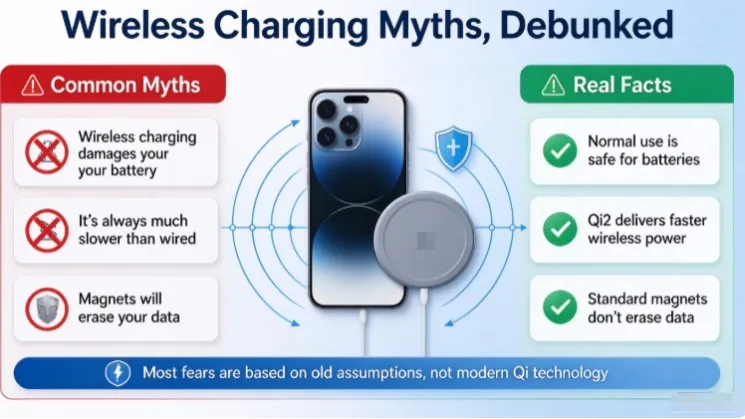
Wireless charging has moved from a novelty into everyday life for hundreds of millions of people. Yet misconceptions still travel faster than the technology itself. Between rumors about battery damage, fears about safety, and confusion about how far a charger can reach, it is easy to mistake folklore for fact. This article walks through the most persistent wireless charging myths and replaces them with clear, sourced information drawn from the Wireless Power Consortium (WPC), the organization behind the Qi standard.
Myth 1: Wireless charging is always much slower than a cable
This was closer to true in the early days, when low-power pads delivered only a trickle of energy. The standard has since evolved. Qi, which the WPC first launched in 2010, introduced magnetic attachment alignment with Qi v2.0 in 2023, delivering 15W. It was adopted across more than 1.5 billion devices in its first year. That momentum continued with Qi2 25W, released as specification version Qi v2.2.1 in July 2025. That update raised power by nearly 70% compared with the first generation of Qi2 and can take a device from 0 to 50% in roughly 30 minutes.
Speed, in other words, is no longer a fixed ceiling. It depends on whether the charger and device both support the latest high-power profiles — not on the mere fact that charging happens without a plug.
Myth 2: Wireless charging ruins your battery
A common worry is that topping up on a pad wears a battery out faster than plugging in. The opposite is often closer to the truth. Battery longevity is strongly influenced by how deeply a battery is discharged. Research cited by the WPC indicates that limiting the depth of discharge to about 50% rather than draining to 100% can extend battery life by roughly four times. In practice, wireless charging encourages exactly this behavior: short, frequent top-ups that keep a battery in a comfortable middle range instead of running it down to empty. A charging pad on a desk makes those small top-ups effortless.
Myth 3: Wireless charging is wildly inefficient
Efficiency is not an afterthought — it is one of the three core values the WPC built the Qi standard around, alongside safety and interoperability. Qi charging relies on magnetic induction: alternating current in a transmitter coil creates an alternating magnetic field, which induces a current in a receiver coil inside the device. Because the coils must be well aligned to transfer energy well, the standard has invested heavily in alignment technologies, including the magnetic attachment introduced in Qi v2.0. Good alignment is what keeps the transfer efficient, which is why the ecosystem keeps pushing toward better positioning rather than exotic distance.
Myth 4: Every wireless charger works with every phone
Interoperability is a founding goal of Qi, but "works with everything" is not the same as "any cheap pad will do." Only products that pass certification may carry the Qi or Qi2 logo. Certification is carried out by independent authorized test labs, and only WPC members can apply for it. There are now more than 13,000 Qi-certified products worldwide. Choosing a device that carries the mark is the simplest way to know it has been tested for safe, reliable cross-brand performance.
Myth 5: Wireless charging works across a room
This is one of the most enduring myths. Qi is a near-field technology by design. It requires the transmitter and receiver to be close together, with the coils aligned. Far-field wireless power — beaming energy over distance — remains limited in commercial use because of cost, efficiency and safety constraints, which is precisely why the WPC continues to focus on near-field solutions. So a phone will not charge from across the house, and it will not charge simply by being somewhere in the same room.
Myth 6: Wireless charging is a health risk
Safety is written into the standard's core purpose, not bolted on afterward. Because Qi operates in the near field, energy transfer is concentrated in the immediate space between the device and the charger rather than being broadcast outward. That proximity is a deliberate design choice that keeps the transfer controlled. Combined with independent testing during certification, this is why regulated, certified products are the ones to trust.
Myth 7: Wireless charging is a gimmick that will fade
The installed base tells a different story. Beyond phones, the same underlying approach is expanding into new categories, including AR/VR headsets and magnetic accessories, and a separate effort called Ki is bringing the same thinking to cordless kitchens. When a standard reaches tens of thousands of certified products and over a billion devices, it is infrastructure, not a fad.
FAQ
Is wireless charging safe to use overnight?Certified Qi products are designed around safety as a core value and are tested by independent labs. Following the manufacturer's guidance is the best practice for any device.
Why is my charging speed lower than advertised?High power such as Qi2 25W requires support on both the charger and the device, plus good coil alignment. If either side lacks the profile, the charger falls back to a lower rate.
Does wireless charging need an internet connection?No. The energy transfer uses magnetic induction and needs no network. Some authentication features use certificates, but charging itself does not depend on connectivity.
Facts sourced from the Wireless Power Consortium.