Oct 9, 2026
How to Choose a Wireless Charger: A Buyer's Checklist
Learn how to choose a wireless charger with confidence. Check certifications, Qi2 power, alignment, and compatibility before you buy.
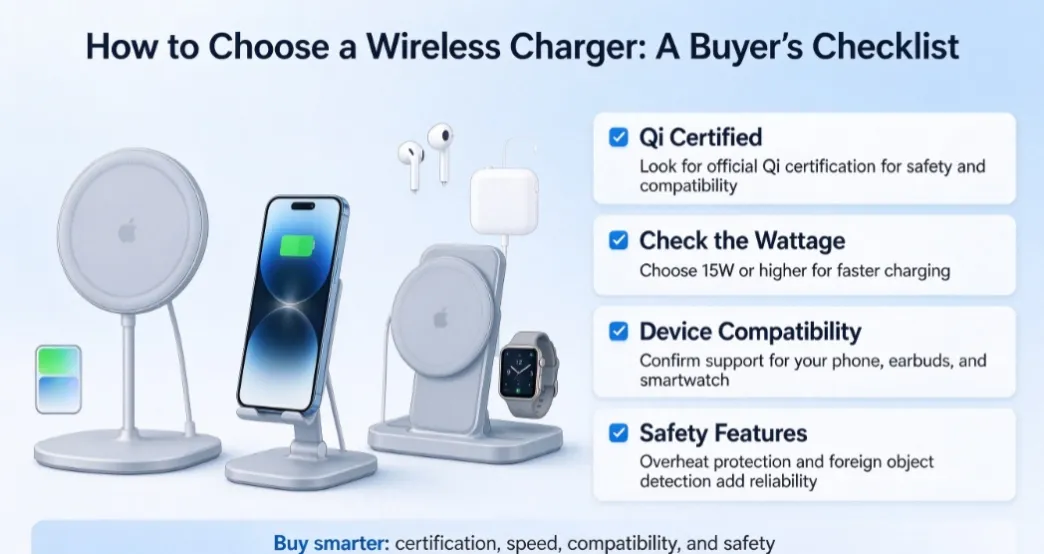
Why This Decision Matters More Than It Looks
Wireless chargers look almost identical on a shelf, yet they are not interchangeable. Some will charge a phone quickly and reliably; others will frustrate you with slow speeds or a connection that drops whenever the device shifts. The difference comes down to a handful of details that are easy to check once you know what to look for.
This guide walks through those details in the order that matters most. Each one is grounded in how the underlying standard works — the Qi and Qi2 specifications created by the Wireless Power Consortium (WPC), the organization behind wireless charging as we know it.
Start With Certification
The single most important check is certification. Only products that have passed testing may carry the Qi or Qi2 logo, and only WPC members are eligible to apply for certification. Certified products are evaluated by independent, authorized test labs — a process that averaged about 24 days in 2026.
That logo is not decoration. It tells you the charger has been verified for safety, efficiency, and interoperability, the three principles the WPC builds into every standard. An uncertified charger of unknown origin offers no such assurance, and it is the easiest thing in the world to avoid.
Understand the Power Level
The next question is how much power the charger delivers, because this directly shapes speed. Qi launched in 2010 and has evolved steadily since. Qi v2.0, introduced in 2023, added magnetic alignment and 15W charging.
The bigger jump came in July 2025, when the WPC's Qi v2.2.1 specification introduced Qi2 25W. It delivers nearly 70% more power than the first generation of Qi2 and can take a device from empty to 50% in roughly 30 minutes. If fast charging is a priority, look for a charger that supports Qi2 25W rather than assuming any wireless charger will be quick.
Check for Magnetic Alignment
Magnetic alignment is one of the most practical improvements in recent years. Before it, a phone that slid slightly off-center could slow down or stop charging. With Qi v2.0, magnets in the charger and the device snap into the correct position, holding the connection steady.
This feature matters even more in motion or on a crowded desk. It also helps smaller devices: a watch or a pair of earbuds presents a tiny charging target, and magnetic positioning removes the guesswork. If your devices support it, magnetic alignment is worth prioritizing.
Confirm Compatibility With Your Devices
Wireless charging is built around interoperability, which is one of the WPC's core principles. The whole point of a standard is that a certified charger should work with a certified device, regardless of brand.
Still, it is worth confirming that your phone, earbuds, or watch support wireless charging and which Qi generation they use. A charger that supports Qi2 25W is a forward-looking choice, while matching the standard your devices already use ensures you get the most out of what you own. Because Qi-certified products now number more than 13,000 worldwide, you are unlikely to struggle to find a charger that fits.
Look for Security Features
Reliability is also about trust. The WPC builds security into its specifications: Qi 1.3 and Qi 2.0 require Extended Power Profile (EPP) and Magnetic Power Profile (MPP) chargers to include a public key certificate, a form of PKI authentication. In plain terms, this is a way for a charger to prove it is genuine — a legitimate part of the buying decision for a device that sits on a pad overnight.
Think About Where You Will Use It
Finally, consider the setting. Wireless charging is a near-field technology, so a device must sit close to the charger — which is fine for a nightstand or a desk, where devices naturally rest.
That same convenience is spreading into public life. WPC members have installed Qi-certified chargers in thousands of restaurants, hotels, public transport systems, and coffee shops worldwide, and with the rollout of Qi2 and Qi2 25W, the WPC expects public wireless charging to become common even faster. If you often charge on the go, choosing certified devices that work across these surfaces pays off.
The Checklist, in Short
- Confirm the Qi or Qi2 logo, which signals certification by independent, authorized test labs.
- Check the power level, and look for Qi2 25W if speed matters.
- Choose magnetic alignment for steadier, easier charging.
- Verify compatibility with your phone, watch, or earbuds.
- Look for security features such as public key certificates.
- Match the charger to where you will actually use it.
Wireless power is still advancing, with magnetic alignment, higher power, and broader public infrastructure arriving in quick succession. Choosing a certified charger today means you are not just buying for the device in your hand — you are buying into a standard designed to keep working as the ecosystem grows.
FAQ
Is Qi2 25W worth it?If charging speed matters, it is a strong choice. Introduced with the Qi v2.2.1 specification in July 2025, Qi2 25W delivers nearly 70% more power than the first generation of Qi2 and can reach 50% charge in roughly 30 minutes.
Can one wireless charger work with all my devices?Interoperability is a core principle of the WPC's standards, so a certified charger should work with certified devices. Confirm that your phone, watch, or earbuds support wireless charging and which Qi generation they use.
Facts sourced from the Wireless Power Consortium.