Oct 8, 2026
Wireless Charging for Wearables: Watches, Earbuds, and Beyond
Wireless charging for wearables keeps watches and earbuds topped up with ease. Learn how Qi and Qi2 power small devices and what comes next.
Small Devices, Big Charging Problem
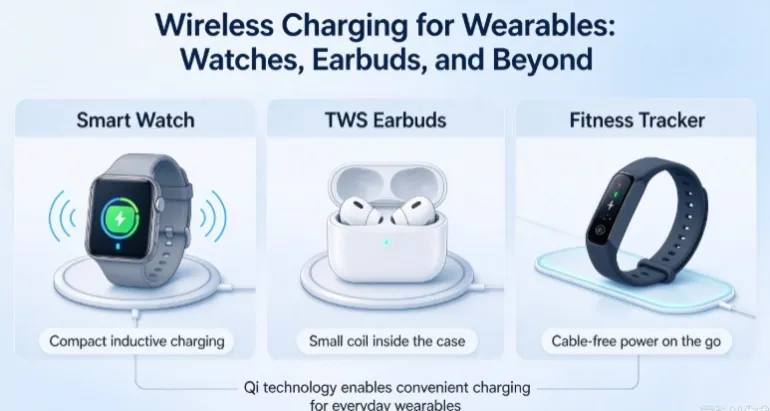
Wearables have a habit of being the devices we rely on most and charge most often. A smartwatch tracks sleep, workouts, and heart rate, then needs recharging before bed. Earbuds get tucked away after every call and every commute. These are small devices with small batteries, and they spend a surprising amount of time near a power source.
That is exactly why wireless charging has become such a natural fit for wearables. The technology behind it comes from the Wireless Power Consortium (WPC), whose Qi standard launched in 2010 and now covers more than 13,000 certified products worldwide. For watches and earbuds, wireless power turns the daily chore of charging into something closer to simply setting a device down.
How Wireless Power Fits Wearables
Wireless charging relies on magnetic induction. A transmitter and a receiver sit close together, and energy moves between them through a magnetic field — no exposed contacts, no plug, no cable. Because this is a near-field technology, the device must be placed near the charger, which is precisely how wearables are used anyway: dropped onto a stand, a pad, or a case.
Small devices benefit from the same safety and efficiency advantages that make wireless power appealing everywhere. With no metal contacts and no physical connector, there is nothing to corrode, bend, or wear out — a real advantage for something like earbuds that may be seated and removed dozens of times a week.
The Case for Topping Up
Wearable batteries are small, so how they are charged matters. Limiting depth of discharge to about 50% instead of draining to 100% can improve battery lifespan by roughly four times, and frequent, small top-ups are gentler on a battery than deep discharge cycles. That pattern is a natural match for wearables: a watch that rests on a charger overnight, or earbuds that return to their case between uses, is effectively being maintained with consistent, low-stress charges.
This is one reason wireless charging suits wearables so well. The devices lend themselves to short, regular charging sessions, and the standard supports exactly that behavior.
Magnetic Alignment Ends the Guesswork
Anyone who has owned an early wireless charger knows the frustration of a device that stops charging because it shifted slightly out of place. The WPC solved this with Qi v2.0, introduced in 2023, which added magnetic alignment and 15W charging. Magnets in the charger and device snap together, keeping them correctly positioned.
For small devices, alignment is even more important. A watch or an earbud offers a tiny charging target, so a magnetic connection removes the need to fuss over placement. Qi v2.0 reached over 1.5 billion devices in its first year, signaling broad adoption of the magnetic approach.
Faster Charging With Qi2 25W
The next advance arrived in July 2025, when the WPC's Qi v2.2.1 specification introduced Qi2 25W. It delivers nearly 70% more power than the first generation of Qi2 and can bring a device from empty to 50% in roughly 30 minutes. For wearables, that kind of speed is transformative: a device with a small battery can reach a useful charge in the time it takes to get ready in the morning.
Trust, Security, and Interoperability
The WPC's standards rest on three principles: safety, efficiency, and interoperability. Certification is how they are upheld. Products are evaluated by independent, authorized test labs, and only certified products may display the relevant logo. Only WPC members can apply for certification, a process that averaged about 24 days in 2026.
Security is built in as well. Qi 1.3 and Qi 2.0 require Extended Power Profile (EPP) and Magnetic Power Profile (MPP) chargers to include a public key certificate, a form of PKI authentication. That helps confirm a charger is genuine, which matters for devices people wear against the skin and leave charging overnight.
Interoperability is the everyday benefit. Because Qi-certified chargers and devices share one standard, a single pad can serve a phone, earbuds, and a watch, rather than a different cable for each. That simplicity is a large part of why wireless charging has moved from novelty to norm.
Where Wearable Charging Goes Next
Wireless power is an evolving platform. Qi v2.0 brought magnetic alignment; Qi2 25W brought speed. The WPC notes that the technology is being explored for future categories such as AR/VR headsets and magnetic accessories — devices that share the same need for easy, contact-free charging.
Public infrastructure is growing alongside. WPC members have installed Qi-certified chargers in thousands of restaurants, hotels, public transport systems, and coffee shops worldwide, and the organization expects public wireless charging to spread even faster as Qi2 and Qi2 25W become common. For anyone wearing a watch or carrying earbuds, that means more places where a quick top-up is simply a matter of setting the device down.
FAQ
Do smartwatches and earbuds use Qi wireless charging?Many wearables charge wirelessly, and the underlying technology comes from the WPC's Qi standard, which covers more than 13,000 certified products worldwide. Magnetic alignment, added in Qi v2.0, helps small devices stay correctly positioned.
Is wireless charging good for small wearable batteries?Frequent, small top-ups are gentler on a battery than deep discharge cycles, and limiting depth of discharge to about 50% rather than 100% can improve lifespan by roughly four times. Wearables that charge in short, regular sessions suit this pattern well.
Facts sourced from the Wireless Power Consortium.