Oct 8, 2026
Ki Cordless Kitchen: How Wireless Power Is Coming to Cooking
Ki cordless kitchen brings wireless power to cooking. Discover how the Ki standard works and how it could reshape cooking, meal prep, and kitchen design.
Ki Cordless Kitchen: How Wireless Power Is Coming to Cooking
The Kitchen Is the Last Room Full of Cables
Walk into almost any modern kitchen and you will see the same scene: a countertop crowded with appliances, each one trailing its own power cord. Blenders, kettles, rice cookers, mixers and coffee machines all compete for the same few wall sockets. The result is a tangle of wires that is awkward to clean around, limits where appliances can sit, and makes the room feel more like a workshop than a place to cook.
The Wireless Power Consortium (WPC) — the organization behind the Qi wireless charging standard found in phones and earbuds — believes the kitchen is ready for a wireless rethink. Its answer is called Ki, a standard created specifically for what the organization describes as the cordless kitchen. The idea is easy to state and ambitious to deliver: power appliances without a cord at all.
What Is the Ki Standard?
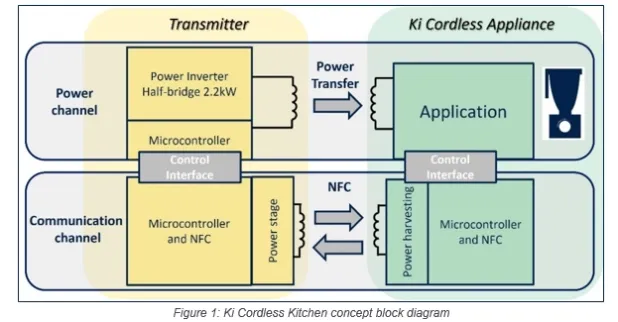
Ki is a wireless power standard developed by the WPC for kitchen appliances. Where Qi was built to charge small electronics such as phones and earbuds, Ki is aimed squarely at the countertop. The consortium's goal is a kitchen where cooking devices receive power through a surface rather than a plug, taking the cord out of the equation entirely.
The WPC frames the technology as more than a convenience feature. In its own words, the cordless kitchen changes cooking, meal preparation, and even the way kitchens are designed. That is a bold claim, but it follows from a single technical change: remove the cable, and the constraints it imposes disappear with it.
How Wireless Power Actually Works
Wireless power, at its core, relies on magnetic induction. A transmitter and a receiver are placed close together, and energy passes between them through a magnetic field — no metal contacts, no exposed plug, no physical connection. This approach works over short distances, which is why wireless power is described as a near-field technology. Devices must sit near their power source rather than anywhere in a room.
That near-field limitation is not a weakness; it is part of what makes wireless power safe and efficient. Because energy transfers only across a small gap, there is little waste and little exposure. Longer-range "far-field" approaches, by contrast, remain limited in commercial use because of concerns about cost, efficiency, and safety.
Why the Kitchen Is a Natural Fit
Countertop appliances are almost always used in the same place. A kettle sits on its base; a blender sits on a counter. Because these devices rarely travel far, the near-field nature of wireless power suits them well. The appliance and the power source simply need to be aligned, and the cooking surface itself becomes the power source — so placement is decided by how you cook rather than by where the nearest outlet happens to be.
What Changes for Cooking and Meal Prep
The WPC highlights cooking and meal preparation as two areas that a cordless kitchen reshapes. When appliances are not anchored to a socket, moving them becomes trivial: you can shift a device along the counter, bring it closer to the sink, or slide it out of the way without unplugging anything. Cleanup gets simpler too, because there is no cord to work around or wipe beneath.
What Changes for Kitchen Design
Kitchen design, the WPC notes, is another area the cordless kitchen will change. When countertops can deliver power directly, the layout of a kitchen no longer has to revolve around a ring of electrical outlets. That opens the door to cleaner surfaces, more flexible island designs, and workspaces that adapt to different tasks.
Safety, Certification, and Trust
For the WPC, three principles guide every standard it writes: safety, efficiency, and interoperability. Those values matter even more in a kitchen, where heat, water, and food are all part of daily use. Certification is how the organization enforces them. Independent, authorized test labs evaluate products, and only certified products are allowed to carry the relevant logo. Only WPC members can apply for that certification.
This is consistent with how the consortium handles its Qi standards. Qi 1.3 and Qi 2.0 both require Extended Power Profile (EPP) and Magnetic Power Profile (MPP) chargers to include a public key certificate, a form of PKI authentication. The same seriousness about trust runs through the WPC's broader work, and a cordless kitchen will depend on that trust as much as it depends on the technology.
The Wider Wireless Power Story
Ki does not exist in isolation. It sits alongside Qi, the standard that launched in 2010 and now spans more than 13,000 certified products worldwide. Qi v2.0, introduced in 2023, added magnetic alignment and 15W charging, reaching over 1.5 billion devices in its first year. In July 2025, the WPC's Qi v2.2.1 specification brought Qi2 25W, delivering nearly 70% more power than the first generation of Qi2 and taking a device from empty to 50% in roughly 30 minutes.
FAQ
Is the Ki cordless kitchen available now?
Ki is a WPC standard for cordless kitchen appliances. As with other WPC standards, products are expected to go through independent testing and certification before carrying the relevant logo.
How is Ki different from Qi?
Qi is designed for small electronics such as phones and earbuds, while Ki targets kitchen appliances and the cooking surface. Both share the WPC's core principles of safety, efficiency, and interoperability.
Facts sourced from the Wireless Power Consortium.