Oct 9, 2026
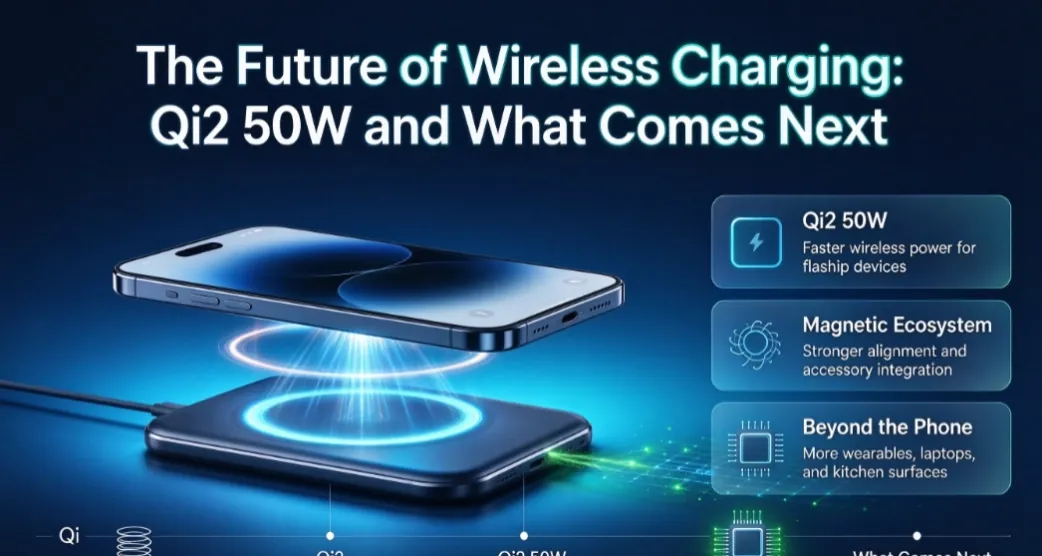
The Future of Wireless Charging: Qi2 50W and What Comes Next
Qi2 50W is on the horizon. Explore the next era of wireless charging, from magnetic accessories to AR/VR and cordless kitchens.
The Future of Wireless Charging: Qi2 50W and What Comes Next
Introduction: A Standard That Keeps Moving
Wireless charging is often described as if it arrived fully formed. It did not. It has been a moving target since the Wireless Power Consortium (WPC) launched Qi in 2010, and the pace has only accelerated — from the original Qi spec, to Qi v2.0 with magnetic alignment in 2023, to Qi2 25W in July 2025.
Now the standard is reaching for something bigger. Qi2 50W is a proposed next step, and it is worth understanding both what it could mean and how the ground is being prepared for it today.
From 25W to 50W: The Trajectory
The recent history of Qi is a story of compounding capability. Qi v2.0 introduced magnetic attachment, which aligns the coils automatically. That alignment is the enabling technology behind higher power, because aligned coils transfer energy more efficiently.
It paid off quickly. Qi2 25W (Qi v2.2.1) increased charging power by nearly 70% over the initial Qi2 generation, with a WPC benchmark of 0 to 50% in about 30 minutes. In its first year, Qi2 reached more than 1.5 billion devices.
A proposed Qi2 50W would extend that trajectory further. Development has been a genuinely collaborative effort: experts from technology companies in multiple countries have met in Beijing to advance the development of this proposed standard — a reminder that the future of wireless charging is negotiated, not simply announced.
Why Alignment Keeps Unlocking More Power
It is tempting to think of "more watts" as a simple dial. In wireless charging, higher power depends on doing the fundamentals well.
The mechanism is magnetic induction: an alternating current in the transmitter coil creates a changing magnetic field, and a receiver coil induces a current from it. The challenge has always been keeping the coils aligned and moving energy efficiently, controllably, and safely.
Magnetic alignment solved the positioning problem, and each subsequent power increase builds on that foundation. This is why the progression from Qi2 to Qi2 25W — and potentially to Qi2 50W — follows a logical curve rather than a marketing one. Better alignment enables better efficiency; better efficiency makes more power practical.
Beyond Phones: Where Wireless Charging Is Heading
The most interesting part of the future is not how much power flows, but where it flows.
Magnetic accessories. Magnetic attachment does more than center a phone. It enables accessories that snap on magnetically — a design language that is spreading across the ecosystem. Once alignment is solved, connecting things magnetically becomes a default interaction.
AR/VR headsets. Headsets and wearables are a natural next frontier. The WPC explicitly points to AR/VR headsets among the new form factors that magnetic locking opens up. In a category where cables are especially inconvenient, wireless charging is a genuine fit.
Cordless kitchens. Perhaps the boldest direction is the Ki standard, which targets the cordless kitchen. Applying wireless power to appliances is a different scale of ambition than charging a phone — and it shows how far the underlying technology can extend.
Together, these point to a simple idea: wireless charging is evolving from a feature on a phone into an ecosystem standard.
What Stays the Same: Safety, Efficiency, Interoperability
However the power numbers grow, three principles anchor the standard: safety, efficiency, and interoperability. They are not aspirations; they are enforced.
Every Qi Certified product must pass safety and interoperability testing in an independent, authorized test lab before it may carry the Qi or Qi2 logo. Only WPC members may apply, and as of 2026 the average certification process takes about 24 days. The WPC also runs dedicated Interoperability Testing Centers and, under the Qi 1.3 and Qi v2.0 specs, requires EPP and MPP chargers to carry a public key certificate as part of a PKI system.
That structure is what allows the standard to scale safely. Push power higher without it and you get fragmentation and risk; push it higher with it and the whole ecosystem benefits.
Sustainability and the Everyday Future
Two quieter themes shape what comes next.
Sustainability. Wireless charging removes the cable — and with it, the mechanical stress that cables and charging ports endure. No plug to wear out, no port to strain. For devices that are otherwise discarded when a port fails, that is a meaningful reduction in e-waste.
Ubiquity in public spaces. Wireless charging is already quietly spreading beyond the home. WPC members have installed Qi Certified chargers in thousands of restaurants, hotels, public transport, and coffee shops around the world. The future of wireless charging is not only a faster pad on your desk — it is a pad already waiting at the table.
One boundary is worth noting: Qi is a near-field technology, and far-field power transfer remains limited by cost, efficiency, and safety. The realistic future is wireless power that is faster, smarter, and far more available in the places you already are.
The Road Ahead
If the last few years are any guide, the next ones will be defined by three movements: more power (toward Qi2 50W), more places (accessories, headsets, kitchens, public venues), and more trust (certification and security baked in from the start). Qi2 50W is not the destination — it is the next milestone on a road the industry is still building together.
FAQ
What is Qi2 50W?
A proposed next-generation standard. Experts from technology companies in several countries have met in Beijing to advance its development.
Does higher power come at the cost of safety?
The standard's core principles — safety, efficiency, and interoperability — remain enforced through independent, authorized testing and certification.
Will wireless charging replace cables everywhere?
Qi is a near-field technology, so far-field applications remain limited. The growth is in speed, new device categories, and public availability.
Facts sourced from the Wireless Power Consortium.