Oct 9, 2026
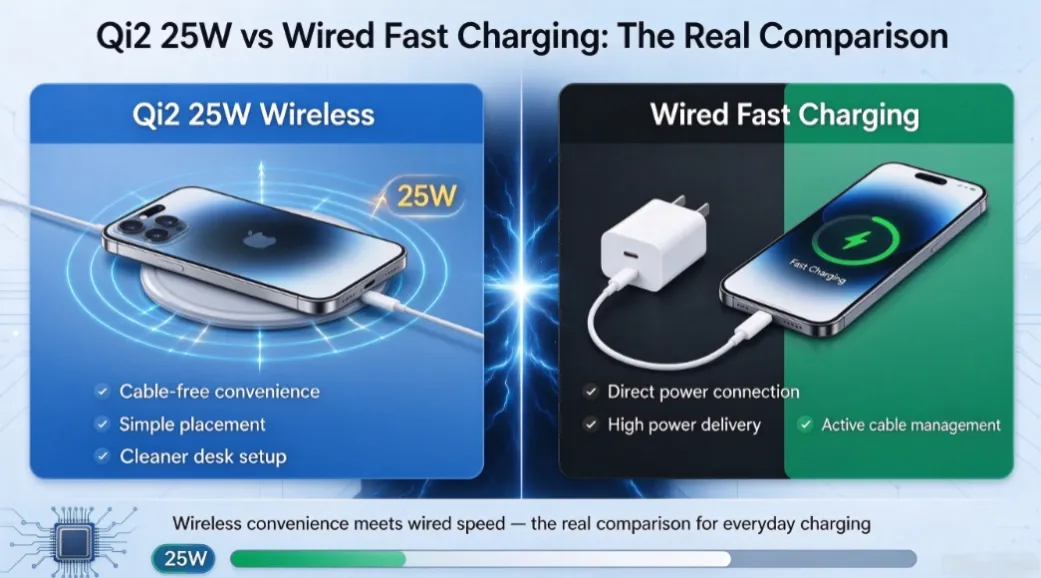
Qi2 25W vs Wired Fast Charging: The Real Comparison
How does Qi2 25W compare with wired fast charging? See where wireless now closes the gap, and where a cable still wins, in plain terms.
Qi2 25W vs Wired Fast Charging: The Real Comparison
Introduction: The Gap Has Been Closing
For years, the case for wireless charging came with an asterisk. Yes, it was convenient. No, it was not as fast as plugging in a cable. That asterisk is finally being challenged.
With Qi2 25W, the Wireless Power Consortium (WPC) has pushed wireless charging power up to a point where, for most everyday situations, the practical difference between setting a phone down and hunting for a cable has shrunk dramatically. This article compares the two approaches honestly — where wireless has caught up, and where a cable still has an edge.
What Qi2 25W Actually Delivers
The first thing to clear up is the name. Qi2 25W corresponds to the Qi v2.2.1 specification, introduced in July 2025. It builds on Qi2, which itself arrived as Qi v2.0 in 2023 with a key innovation: magnetic alignment.
That magnetic attachment is not a gimmick. By snapping the device and charger into the correct position, magnets keep the coils aligned — and aligned coils transfer energy more efficiently, which is what makes higher power practical. Qi2 25W raises charging power by nearly 70% over the initial Qi2 generation.
The headline benchmark from the WPC is easy to remember: charging a smartphone battery from 0 to 50% in about 30 minutes. That is the number to hold onto when weighing wireless against a cable, because it describes the scenario most people actually care about — a quick top-up, not a full overnight charge.
Where Wireless Now Wins
Think about how people really charge. Most daily charging is not a zero-to-full marathon; it is a series of short sessions — on a desk during work, on a nightstand, on a café table. In that pattern, Qi2 25W's fast top-up is not a compromise. It is a match.
Three advantages stand out:
- Convenience without a speed penalty. A 0-to-50% charge in roughly half an hour covers the "I need power now" case that used to force a cable.
- No wear at the port. Plugging and unplugging a cable stresses the charging port and can wear out the connector over time. Wireless charging eliminates that mechanical stress entirely, since there is no cable to insert and remove.
- Alignment that helps efficiency. Because magnetic attachment keeps the coils aligned, energy reaches the device more directly, rather than being lost to misalignment.
Where a Cable Still Has an Edge
A fair comparison requires acknowledging the wired case, and it remains strong in specific scenarios.
- Full, fastest charges. For getting a device from empty to completely full as quickly as technically possible, a direct wired connection remains the reference point. Qi2 25W closes most of the gap for the 0-to-50% window, but it is a fast-charging benchmark rather than a claim to outrun every wired method.
- Cost and ubiquity. Cables are cheap, and they are everywhere. Wireless chargers require a power source and a Qi-compatible device, and higher-power wireless charging depends on a charger that meets the relevant standard.
- Charging while in use, tethered. Some users prefer the certainty of a physical connection during heavy use, even if it means being attached to a cable.
None of these make wired charging "better" in the abstract — they simply describe the cases where a cable still makes sense.
The Alignment Factor Deserves Its Own Mention
The shift from earlier Qi to Qi2 was fundamentally a shift in alignment. With magnetic attachment, the device is positioned correctly every time, automatically. This matters for the comparison because misalignment was historically one of the hidden reasons wireless charging felt slower and less efficient than it should be.
When coils line up, three of the standard's core principles work together: efficiency improves, safety is easier to maintain because the transfer is controlled, and the experience becomes interoperable and predictable. Qi2 25W leans on all three.
Certification: The Detail That Keeps the Comparison Honest
Speed claims only mean something if the product is trustworthy. That is why certification belongs in any real comparison.
A product can only carry the Qi or Qi2 logo if it has passed safety and interoperability testing in an independent, authorized test lab. Certification is open only to WPC members, and as of 2026 the average process takes about 24 days. With more than 13,000 Qi Certified products in the market, the logo is what tells you a charger delivers the standard's behavior — not just the numbers on its packaging.
So when you weigh Qi2 25W against a cable, the logos are part of the evidence.
The Verdict, in Plain Terms
If your priority is the fastest possible full charge under every condition, a cable remains the tool for the job. If your priority is charging the way people actually live — frequently, briefly, without hunting for a cord — Qi2 25W has made wireless a genuine first choice rather than a compromise.
The gap has not vanished; it has narrowed to the point where, for daily top-ups, choosing wireless is no longer about accepting slower charging. It is about how you prefer to charge. And increasingly, the answer is simple: set it down and go.
FAQ
Is Qi2 25W really about 70% faster than earlier Qi2?
Yes. Qi2 25W (Qi v2.2.1, July 2025) raises charging power by nearly 70% over the initial Qi2 generation.
How fast can Qi2 25W charge a phone?
WPC cites roughly 0 to 50% in about 30 minutes — the benchmark that matters most for quick top-ups.
Does wireless charging still lag a cable?
For the fastest possible full charge, a cable retains an edge. For frequent short charging, Qi2 25W has largely closed the practical gap.
Facts sourced from the Wireless Power Consortium.