Oct 9, 2026
Wireless Charging Safety: EMF, Heat, and Foreign Objects
Is wireless charging safe? Understand EMF, heat, and foreign-object concerns, and how Qi certification tests chargers before they earn the logo.
Wireless Charging Safety: EMF, Heat, and Foreign Objects
Introduction: Convenience Comes With Questions
Wireless charging has quietly become the default way many people top up a phone, a watch, or a pair of earbuds. You set the device down, it charges, and you walk away. But the very thing that makes it feel effortless — energy moving through the air with no visible connection — is also what makes people ask whether it is safe.
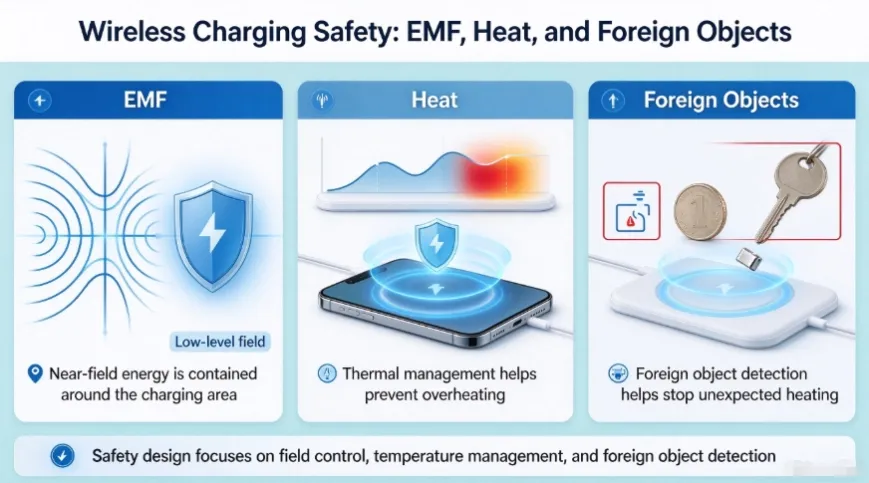
It is a fair question. This article looks at the three concerns that come up most often — electromagnetic fields, heat, and foreign objects — and explains how the wireless charging industry addresses each one through design and, crucially, through independent certification.
First, the Mechanism: Magnetic Induction
To judge any safety question, it helps to understand what is actually happening. Wireless charging works through magnetic induction. A transmitter coil inside the charger is driven by alternating current, which creates an alternating magnetic field. A receiver coil inside the device responds by inducing a current from that field.
Energy crosses the gap between the two coils — through the air, but across a very short distance. This is a near-field system. That word, "near-field," turns out to be central to the safety discussion.
EMF: Why Near-Field Matters
Electromagnetic fields are all around us, and the term can sound alarming out of context. The relevant distinction is between near-field and far-field energy transfer.
Qi wireless charging is a near-field technology. The coils must be close together for energy to transfer, because the field falls off sharply with distance. That is also why alignment matters so much: the tighter the coupling between coils, the more efficient the transfer.
Far-field wireless power — beaming energy across larger distances — is a different beast entirely. Its commercial application remains limited, held back by cost, efficiency, and safety constraints. In practice, that means the wireless charging you encounter on a desk or a bedside table is overwhelmingly a short-range, near-field technology, not a long-distance power beam.
Certification reinforces this. Every Qi Certified product must pass safety testing — alongside interoperability testing — in an independent, authorized test lab. Safety is not assumed from a spec sheet; it is verified by a third party working from a shared standard.
Heat: The Real-World Consideration
If there is one everyday aspect of wireless charging worth paying attention to, it is heat. Moving energy across an air gap is not perfectly lossless, and any inefficiency can show up as warmth.
That is not a flaw unique to wireless charging — wired charging generates heat too — but it is something a well-designed system manages. Two factors shape how much heat a charger produces:
- Efficiency — better-aligned coils and efficient design mean less energy wasted, and less warmth.
- Control — the charging system must regulate how power flows so that it stays within safe limits.
The Qi2 generation addressed alignment directly by adding magnetic attachment, which snaps the device and charger into the correct position. Better alignment means better efficiency, and better efficiency means the energy goes into the battery rather than being lost along the way. Alignment, in other words, is both a convenience feature and a safety-relevant one.
Efficiency is one of the three principles the Qi standard was built on, alongside safety and interoperability.
Foreign Objects: When Something Else Is on the Pad
Another practical scenario any charger must handle is the presence of something other than the intended device — a stray key, a coin, a metal object, or a device that is not meant to be charging.
A wireless charger cannot "see" what has been placed on it, so it relies on design that keeps energy transfer controlled and behavior predictable. Authorized-lab testing evaluates this behavior, so edge cases are examined before a product reaches a nightstand or a café table.
Why Certification Is the Safety Feature You Can Actually Check
Consumers cannot measure magnetic fields, test thermal limits, or probe fault behavior at home. What they can do is check for the Qi or Qi2 logo.
That logo carries a specific meaning: only Qi Certified products may display it, and a product earns it only after passing safety and interoperability testing in an authorized lab. Certification is available only to WPC members, and as of 2026 the average process takes about 24 days — a timeline that reflects genuine testing rather than a rubber stamp.
In a market of more than 13,000 Qi Certified products, the logo is the one safety signal that travels with the product all the way to the shelf.
Putting the Concerns in Perspective
None of the three concerns — EMF, heat, foreign objects — is a reason to avoid wireless charging. Each is a known engineering consideration, which is exactly the kind of thing a mature standard is designed to handle.
The reassuring part is the structure behind the technology. Qi was built around safety, efficiency, and interoperability from the start, and certification converts those principles into independent verification. The result is a system where the invisible thing happening on your desk has already been examined by someone whose only job was to find problems — which is what makes "just set it down" a reasonable thing to do.
FAQ
Is wireless charging the same as far-field power beaming?
No. Qi is a near-field technology that requires coils to be close together. Far-field power transfer remains limited by cost, efficiency, and safety constraints.
Does wireless charging produce heat?
Energy transfer is never perfectly lossless, and inefficiency can appear as warmth. Efficient design and good coil alignment help keep this controlled, which is why Qi certification includes safety testing.
How do I know a charger is safe?
Look for the Qi or Qi2 logo. Only Qi Certified products may display it, and only after passing safety and interoperability tests in an independent, authorized lab.
Facts sourced from the Wireless Power Consortium.