Oct 9, 2026
Inside the Test Lab: How Wireless Chargers Get Certified
Go inside an authorized test lab to see how wireless chargers pass safety and interoperability testing to earn Qi certification from the WPC.
Inside the Test Lab: How Wireless Chargers Get Certified
---
Introduction: The Room Where the Logo Is Decided
Somewhere between a charger's design sketch and the retail shelf, there is a room most shoppers never think about. In that room, a product is run through a series of controlled tests by people who have no stake in whether it passes. Its heat is measured. Its behavior is probed. Its ability to cooperate with other companies' devices is put on trial.
Only after that room gives its verdict may the Qi logo appear on the box.
This is a look inside the certification test lab — not a specific facility, but the standardized process that the Wireless Power Consortium (WPC) requires for every product that wants to call itself Qi Certified.
---
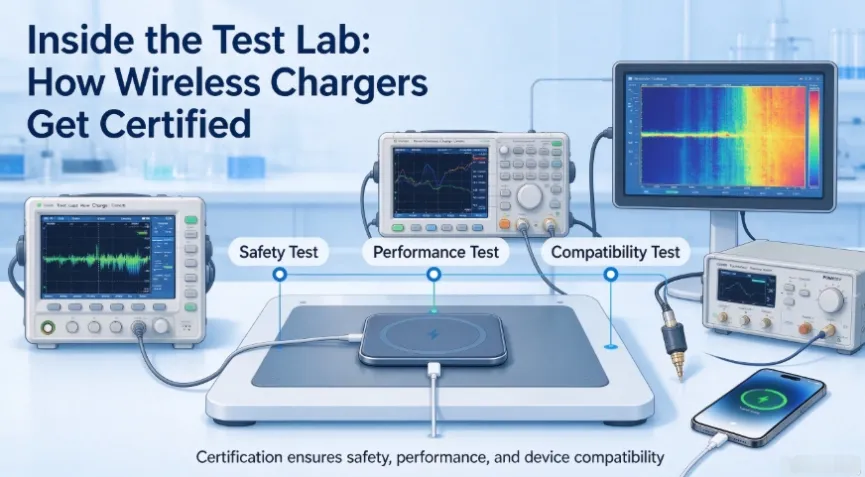
The Two Questions Every Lab Asks
Strip away the equipment and the certification process comes down to answering two fundamental questions:
1. Is this product safe? Does it manage power and heat responsibly, including when something goes wrong?
2. Is this product interoperable? Does it work correctly with the wider world of Qi devices, not just the ones from its own brand?
A charger that passes the first test but fails the second is a charger that only works in a walled garden. A charger that passes the second but fails the first is a hazard. Certification requires both — and the tests are designed to leave no ambiguity.
---
Independence Is the Whole Point
Before any of that testing has meaning, one condition must hold: the lab must be independent and authorized. A manufacturer cannot certify its own product, and it cannot simply declare compliance.
Testing happens in an independent, authorized test lab, precisely so that the result is credible. The person measuring thermal behavior has nothing to gain from a pass. The person checking interoperability is not the person who designed the coil.
This is what separates certification from a marketing claim. The WPC's structure ensures the verdict comes from outside the company selling the product.
---
Testing for Safety
Safety testing looks at how a wireless charger behaves under normal use and under stress. The underlying mechanism matters here: wireless charging relies on magnetic induction, where a transmitter coil driven by alternating current creates a changing magnetic field, and a receiver coil in the device induces a current from it.
Moving energy across an air gap is elegant, but it must be controlled. The engineering challenges are alignment and ensuring the transfer stays efficient and safe. Safety testing examines whether a product keeps that transfer under control — whether it manages the heat that energy transfer can create, and whether it behaves predictably rather than unpredictably.
Because the standard is built on three pillars — safety, efficiency, and interoperability — safety testing is not a formality bolted onto the end. It is one of the reasons the standard exists at all.
---
Testing for Interoperability
If safety testing protects the user, interoperability testing protects the experience. And it is arguably the harder of the two to fake.
Interoperability means a charger must work with devices it did not come bundled with. To verify this at scale, the WPC maintains dedicated Interoperability Testing Centers, where products are tested against a broad range of other certified devices from different manufacturers.
Consider what a single charger must handle: phones of different sizes, different coil positions, different power profiles, and different brands. Each combination is an opportunity for a mismatch. Interoperability testing exists to find those mismatches in the lab rather than on a customer's nightstand.
This is why the WPC's own definition of the standard's value leads with interoperability alongside safety and efficiency. A charger that cannot cooperate is not really compliant.
---
The Paperwork That Comes After
Passing the physical tests is necessary but not sufficient. Modern Qi certification also includes layers of trust that are verified in parallel with the hardware.
The Qi 1.3 and Qi v2.0 specifications require that EPP and MPP chargers carry a public key certificate, part of a Public Key Infrastructure (PKI). This authentication layer helps confirm that a charger is a genuine, certified article rather than a counterfeit wearing a familiar badge.
And the process closes with governance. Certification is not open to everyone: only WPC members may apply, and products must complete the full process — testing in an authorized lab, review, and formal approval — before they can display the Qi or Qi2 logo. In effect, the rule is simple: only Qi Certified products may carry the Qi or Qi2 logo.
---
How Long Does the Whole Thing Take?
Rigor has a timetable. As of 2026, the average certification journey takes about 24 days. That number spans the practical reality of lab scheduling, testing, and formal review.
For a manufacturer, it is a cost of doing business the right way. For a consumer, it is a reason to trust the mark: the badge reflects a process measured in weeks, involving an independent party and a shared standard.
---
Why This Matters to the Ecosystem
Zoom out and the lab process is doing more than approving one charger at a time. With more than 13,000 Qi Certified products on the market, the test lab is what keeps the promise of Qi intact — an unglamorous room that gives a very small symbol its meaning.
---
FAQ
Where does certification testing happen?
In independent, authorized test labs, with interoperability supported by the WPC's dedicated Interoperability Testing Centers.
Can a company test its own charger?
No. Testing must be independent, and only WPC members can submit products for certification.
How long is the certification process?
As of 2026, the average is around 24 days, covering testing, review, and approval.
---
Facts sourced from the Wireless Power Consortium.