Oct 9, 2026
Qi Certification Explained: How a Charger Earns the Logo
See how a wireless charger earns the Qi logo: the WPC's testing process, authorized labs, PKI security, and what certification means for buyers.
Qi Certification Explained: How a Charger Earns the Logo
---
Introduction: A Logo That Carries Weight
Walk into almost any electronics store and you will find wireless chargers stamped with a small, unmistakable mark: the Qi logo. It looks like a piece of branding, but it is actually a claim — a claim that the product inside the box has been independently tested, that it will not damage the device sitting on top of it, and that it will work with chargers and phones made by completely different companies.
That mark is not handed out freely. It is earned through a structured certification program run by the Wireless Power Consortium (WPC), the organization behind the Qi standard. This article explains what Qi certification is, why it exists, and the steps a charger must complete before the logo can legally appear on a retail box.
---
What Qi Is — and Who Controls It
Qi is the global standard for inductive wireless charging of mobile and portable devices. The WPC defined it and first launched it in 2010. Since then, more than 13,000 Qi Certified products have reached the market, spanning phones, chargers, automotive systems, and accessories.
Because a single standard governs all of them, a charger from one brand and a phone from another can generally work together without any special setup. That compatibility is not accidental — it is the entire point of certification.
Three principles sit at the heart of the standard:
- Safety — energy transfer should never put people or devices at risk.
- Efficiency — power should reach the battery with as little waste as possible.
- Interoperability — any compliant device should pair with any compliant charger.
Certification is the mechanism that turns those principles into something a shopper can verify at a glance.
---
Why Certification Exists
Wireless charging moves real power across an air gap between two coils. Done well, it is invisible and safe. Done badly, it can waste energy, generate unwanted heat, or behave unpredictably when a device is not perfectly positioned.
Consumers cannot test for those problems on a spec sheet. They cannot measure coil alignment, thermal behavior, or how a charger reacts to a foreign object. Certification exists to close that gap, replacing trust-me marketing with an independent verdict.
It also protects the ecosystem itself. If uncertified products carried the Qi mark while behaving unpredictably, the whole standard would lose credibility — and consumers would blame "wireless charging" rather than the specific product.
Who Is Allowed to Apply
Certification is a members-only process. Only WPC members can submit products for Qi certification. Membership gives a company access to the specification, the testing infrastructure, and the right to bring compliant products to market under the Qi or Qi2 name.
---
The Testing Journey: Independent, Authorized Labs
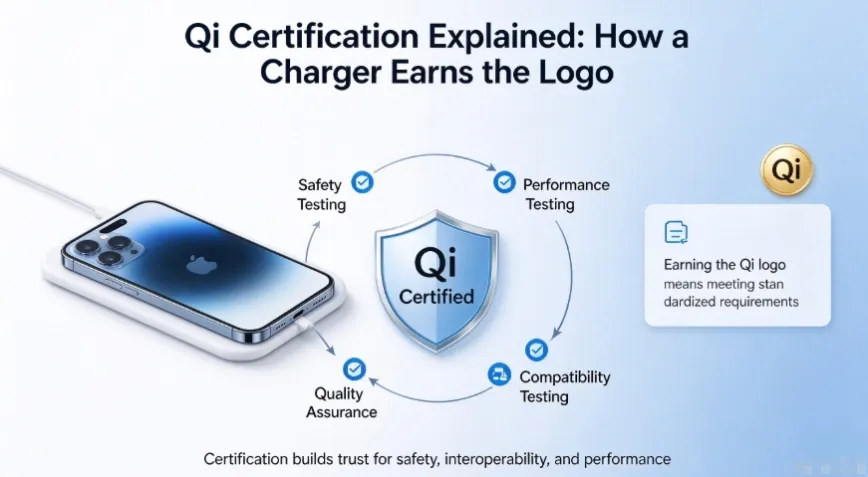
The most important word in the certification process is independent. A product cannot be self-certified by its own manufacturer. Instead, it must pass safety and interoperability testing in an independent, authorized test lab.
Those two testing categories answer two different questions:
1. Safety testing asks whether the product is safe to use — whether it manages heat, power, and fault conditions responsibly.
2. Interoperability testing asks whether the product works correctly with the wider universe of Qi devices, not just the ones from its own maker.
The WPC supports this through dedicated Interoperability Testing Centers, where products are exercised against a broad range of other certified devices. A charger that only works with one brand's phone has not proven interoperability — it has proven a pairing.
The result is a badge that means something specific: this product was tested by a third party, against a shared standard, on behalf of every consumer who will ever place a phone on it.
---
What the Logo Actually Means
Once a product passes, it earns the right to display the Qi or Qi2 logo. The rule is strict and easy to remember: only Qi Certified products may carry the Qi or Qi2 logo.
That single sentence is the reason the logo is worth looking for. It is not decorative, and it is not available to products that merely "support" wireless charging in a loose sense. If the mark is present, the product completed the process. If it is absent, no matter how premium the packaging looks, the claim has not been independently verified.
---
Security Beyond the Surface: Public Key Certificates
Modern Qi certification also addresses trust in a more technical sense. The Qi 1.3 and Qi v2.0 specifications require that Extended Power Profile (EPP) and Magnetic Power Profile (MPP) chargers carry a public key certificate, part of a Public Key Infrastructure (PKI) system.
In plain terms, this gives wireless charging a form of authentication. The certificate helps establish that a charger is a genuine, certified product rather than a look-alike, adding a layer of protection that goes beyond physical testing alone.
---
How Long Does Certification Take?
Certification is thorough, and thoroughness takes time. As of 2026, the average certification timeline is around 24 days. That figure reflects the reality that each product must move through testing, review, and formal approval rather than a simple checklist.
For manufacturers, that window is a planning constraint. For buyers, it is a signal of rigor: the logo represents a process measured in weeks, not minutes.
---
FAQ
Can any company put the Qi logo on a charger?
No. Only Qi Certified products may display the Qi or Qi2 logo, and only WPC members can apply for certification.
Does certification cost manufacturers time?
Yes. As of 2026, the average certification process takes about 24 days, reflecting the testing and review involved.
What does a public key certificate add?
Required for EPP and MPP chargers in the Qi 1.3 and Qi v2.0 specs, it supports authentication of genuine certified products through a PKI system.
---
Facts sourced from the Wireless Power Consortium.