Oct 8, 2026
Public Wireless Charging: Why Cafés, Hotels, and Airports Are Installing Qi
Public wireless charging is spreading fast. See why cafés, hotels, and airports install Qi-certified chargers and what Qi2 25W means for venues.
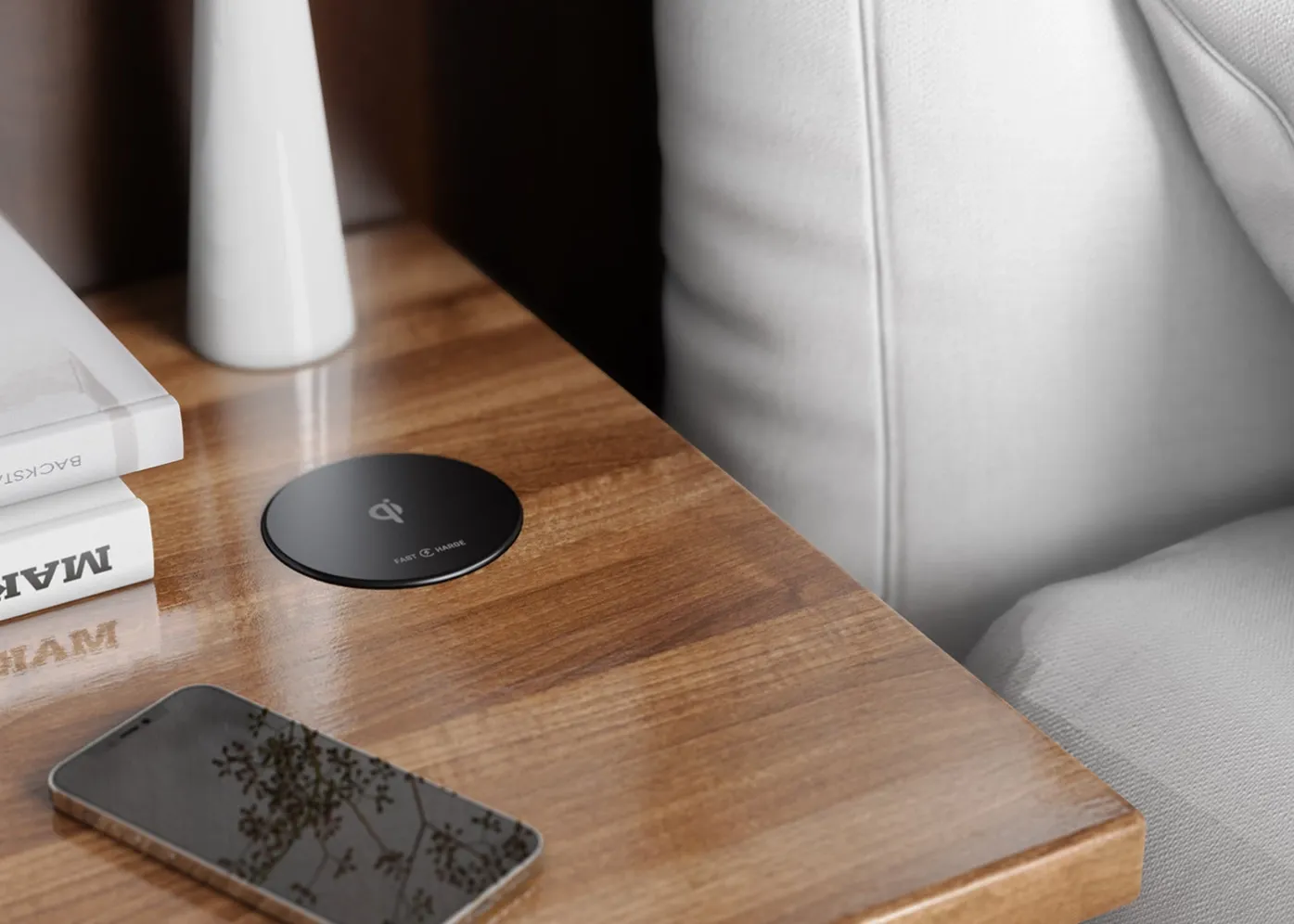
The New Expectation When You Sit Down
A few years ago, finding a power outlet was a small victory. Today, people scan a table almost instinctively, looking not for a socket but for a charging surface. That shift in behavior is being met by real infrastructure. WPC members have already installed Qi-certified chargers in thousands of restaurants, hotels, public transport systems, and coffee shops around the world — and the organization expects that spread to accelerate.
What Makes a Charger "Qi-Certified"
Qi comes from the Wireless Power Consortium (WPC), the organization that has guided the standard since it launched in 2010. Today more than 13,000 Qi-certified products exist worldwide. Behind that number is a certification process designed to protect both businesses and their customers.
Certification means a product has been evaluated by independent, authorized test labs. Only products that pass may carry the Qi or Qi2 logo, and only WPC members are eligible to apply. In 2026, the process averaged about 24 days. For a venue, that logo is a shorthand signal: the charger on the table is genuine, safe, and interoperable, rather than an unverified accessory of unknown quality.
Why Venues Are Making the Switch
For a café or hotel, a public charger has to survive constant, unattended use by strangers. Wireless power handles that well because it relies on magnetic induction, transferring energy across a magnetic field with no exposed contacts. There are no plugs to wear out and no connectors to be bent or broken by careless use.
The WPC's guiding principles — safety, efficiency, and interoperability — map directly onto a venue's needs. Safety matters when a device sits untended in a public space. Efficiency matters when chargers run all day. Interoperability matters most of all: a guest should be able to set down a phone and expect it to charge, without asking which cable fits.
Magnetic Alignment Cleans Up the Experience
Early wireless chargers could be finicky, needing a phone to sit just so. Qi v2.0, introduced in 2023, added magnetic alignment and 15W charging, using magnets to snap a device into the correct position. That refinement made wireless charging far more reliable in busy settings, where a guest will not carefully line up a phone before walking away.
Adoption moved quickly. Qi v2.0 reached over 1.5 billion devices in its first year, which tells venues that a magnetic charging surface will work with a large and growing share of the phones their customers carry.
Qi2 25W and What It Means for Public Spots
The pace picked up again in July 2025, when the WPC's Qi v2.2.1 specification introduced Qi2 25W. It delivers nearly 70% more power than the first generation of Qi2 and can bring a device from empty to 50% in roughly 30 minutes. For a traveler with a short layover or a diner waiting for a meal, that is the difference between a token top-up and a genuinely useful charge.
Faster charging also aligns with how batteries prefer to be treated. Keeping depth of discharge to about 50% rather than fully draining the battery can improve its lifespan by roughly four times, and small, frequent charges are easier on a battery than deep cycles. A charger on a café table or an airport lounge seat turns idle minutes into gentle, battery-friendly top-ups.
Security Guests Can Rely On
Public charging raises a fair question: how does a guest know a charger is legitimate? The WPC builds security into its specifications. Qi 1.3 and Qi 2.0 require Extended Power Profile (EPP) and Magnetic Power Profile (MPP) chargers to include a public key certificate, a form of PKI authentication. That certificate helps verify that a charger is authentic and safe. For venues, it is a way to show that the convenience they offer is backed by a real standard rather than a cost-cutting shortcut.
A Network That Keeps Growing
Public wireless charging is spreading because it solves a problem that both customers and businesses recognize. Customers want power without hunting for a cable; venues want to offer a clean, durable amenity that never becomes a tangle of wires. Qi delivers both, and with the rollout of Qi2 and Qi2 25W, the WPC expects public wireless charging to become common even faster.
Looking ahead, the same near-field approach is being explored for new device categories, from AR/VR headsets to magnetic accessories. As those devices join the phones and earbuds already in every bag, the value of a Qi-certified surface in a public space will only grow.
FAQ
Which venues are installing public wireless charging?WPC members have installed Qi-certified chargers in thousands of restaurants, hotels, public transport systems, and coffee shops worldwide, and the organization expects the trend to accelerate with Qi2 and Qi2 25W.
How do I know a public charger is genuine?Certified products may display the Qi or Qi2 logo, and they are evaluated by independent, authorized test labs. Qi 1.3 and Qi 2.0 also require EPP and MPP chargers to include a public key certificate, a form of PKI authentication.
Are public wireless chargers slow?Speed depends on the charger and device. Qi2 25W, introduced with the Qi v2.2.1 specification in July 2025, delivers nearly 70% more power than the first generation of Qi2 and can reach 50% charge in about 30 minutes.
Facts sourced from the Wireless Power Consortium.