Oct 9, 2026
Is Wireless Charging Bad for Your Battery? The Science, Explained
Wireless charging and battery health, explained: how batteries age, why shallow top-ups help, and what really wears a battery out over time.
Is Wireless Charging Bad for Your Battery? The Science, Explained
A persistent worry follows wireless charging around: that it somehow wears your battery out faster than plugging in a cable. It is a reasonable question, and the honest answer is more interesting than a simple yes or no. To understand it, you need to know a little about how batteries age — and about what wireless charging actually does to them.
The Short Answer
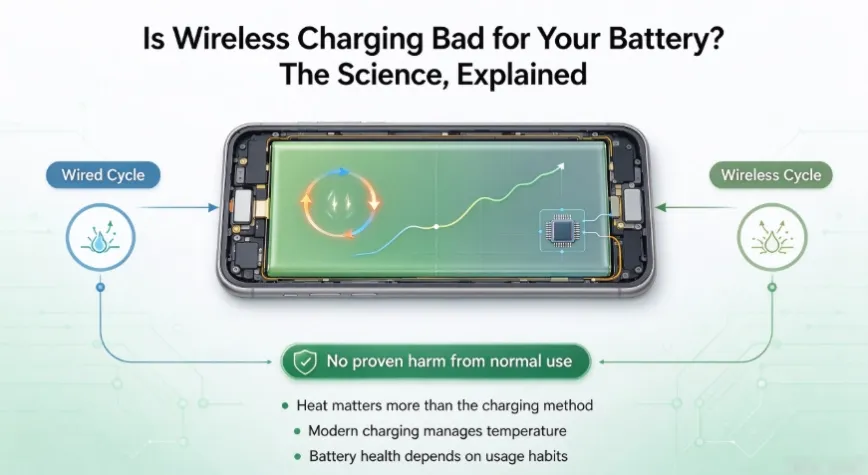
Wireless charging is not inherently harmful to your battery. In fact, how you charge — not whether you use a cable or a pad — is the bigger factor. And when it comes to the way wireless charging encourages you to use your phone, it may even have an edge. The key is to look past the "wireless" label and focus on the charging behaviour underneath it.
How Batteries Age
Most devices run on lithium-based batteries, and these lose capacity as they are charged and discharged over time. Every cycle takes a small toll, and a battery that once lasted all day gradually holds less. This ageing is normal and gradual; it is a property of the chemistry, not a fault of any particular charger. Because the loss is tied to how much the battery is worked, the way you manage charge levels has a direct effect on how long the battery stays healthy.
Why Shallower Beats Deeper
Here is the counter-intuitive part. It might seem that draining a battery fully before recharging — a deep discharge — would be best for it. The opposite is true. Evidence indicates that limiting the depth of discharge to around 50% rather than running all the way to 100% can extend battery life by roughly four times. In other words, keeping the battery in a comfortable middle range, and topping it up in small amounts, is gentler on it than repeatedly running it down and charging it back to full.
What Wireless Charging Does Well
This is where wireless charging has an unexpected advantage. Because a pad is so easy to use, people tend to set their phone down and add a little charge here and there — a "charge often, charge a little" habit that keeps the battery away from the extremes. That pattern of shallow, frequent top-ups aligns with what the science says is gentler on the battery. So the convenience of wireless charging can nudge you toward the very behaviour that helps your battery last.
It also avoids a source of wear that cables introduce. Every time you plug and unplug a cable, you stress the charging port and the connector. Wireless charging removes that mechanical stress entirely, which is good for the device as a whole. And it is one reason the technology fits with a more sustainable approach to electronics: fewer worn-out ports and cables means less to repair and replace, and less electronic waste.
Where Cables Still Win
None of this means cables are bad. Wired charging can deliver higher power in some situations and may generate less heat, and for a full, fast charge it remains a solid choice. The point is that neither method is a villain. A cable is not automatically kinder to a battery, and a pad is not automatically harsher. What matters is how the charge behaves over time.
Heat: The Real Variable
If there is one factor to watch, it is heat. Batteries dislike sustained high temperatures, and any charging method that keeps a battery hot for long periods is unhelpful. Wireless charging can produce warmth, especially if a device is misaligned or a case traps heat. The good news is that modern standards are built with this in mind. Magnetic alignment, introduced with Qi v2.0 in 2023, keeps the coils properly positioned, which helps transfers run more efficiently. The WPC's standards have always been guided by safety and efficiency, and certification testing checks these qualities before a product earns the Qi or Qi2 logo.
A Balanced Routine
If you want to look after your battery, the practical rules are simple and method-agnostic. Avoid leaving a device in the heat. Don't obsess over full discharges. Top up in small amounts when it suits you, whether that means a pad on your desk or a cable by your bed. And choose certified chargers, so that the safety and efficiency the standard promises are actually present in the product you buy.
FAQ
Does wireless charging damage batteries? Not on its own. Battery ageing is driven mainly by cycles and heat, and frequent, shallow top-ups — the kind a pad makes easy — can actually be gentler than deep discharges.
Should I let my phone drain to 0%? Generally no. Limiting discharge depth to around 50% rather than 100% can extend battery life by roughly four times.
Is wired charging better? Not universally. Each has trade-offs. Wired charging may run cooler or deliver more power, while wireless charging avoids port wear and encourages gentler charging habits.
Facts sourced from the Wireless Power Consortium.