
Oct 8, 2026Tech Guides
How Qi Wireless Charging Works: A Beginner's Guide
Discover how Qi wireless charging uses magnetic induction to power your devices — the standard, the science, and why alignment matters.
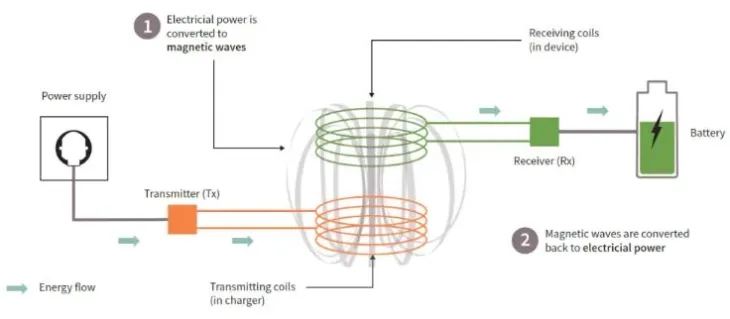
Wireless charging has moved from a novelty to a normal part of daily life. You drop your phone on a pad, hear a soft chime, and a battery icon begins to fill — no cable, no plug, no fumbling for a port in the dark. It feels like magic, but it is physics. This guide explains, in plain language, how Qi wireless charging works, what the Qi standard is, and why the technology behaves the way it does.
What "Wireless Charging" Really Means
A common misunderstanding is that wireless charging sends power through the air across a room. In practice, the charging pads and stands most people use transfer energy over a very short distance — a few millimetres, essentially touching. This is called near-field charging, and it is the approach the Wireless Power Consortium (WPC) focuses on. Longer-range "far-field" power is technically possible, but cost, efficiency and safety constraints have kept commercial applications limited. The everyday wireless charger on your desk is a near-field device.
The Core Idea: Magnetic Induction
At the heart of the technology is a simple principle called magnetic induction. A wireless charger contains a transmitter coil. When an alternating electric current flows through that coil, it generates a magnetic field that changes direction many times per second. Place a compatible device on top, and its receiver coil experiences that shifting field. The changing field induces a current in the receiver coil, which the device converts into the power it needs to charge its battery. Two coils, one changing magnetic field, and no metal contact between them: that is the whole trick.
Where Qi Comes From
The rules that make this work across different brands come from the Wireless Power Consortium, the organisation behind the Qi standard. Qi was first published in 2010, and the WPC's mission centres on three ideas: safety, efficiency and interoperability. Interoperability is the point most consumers notice — a Qi-certified phone from one manufacturer can charge on a Qi-certified pad from another. To date, more than 13,000 Qi-certified products have been brought to market, and the ecosystem now spans phones, earbuds, wearables and more.
What Happens When You Set Your Phone Down
Once a device rests on a pad, a short digital conversation takes place. The pad and the device negotiate: the charger identifies what the device can accept, and the two agree on a safe power level. If a foreign object such as a coin or a set of keys sits between them, a well-designed system detects it and stops transferring power to avoid heating the metal. Good Qi chargers are built around this safety logic, which is one reason certification testing exists.
Why Alignment Matters
Because energy transfer depends on the two coils lining up reasonably well, position has a real effect on performance. Slide a phone too far off-centre and the connection can weaken or drop entirely. This is exactly the problem that magnetic attachment was designed to solve. Introduced with Qi v2.0 in 2023, magnetic alignment pulls the coils into the correct position automatically and enabled faster 15W charging. In its first year, Qi2 reached more than 1.5 billion devices — a sign of how much people value a connection that simply locks into place.
A Standard Built to Keep Growing
Qi has not stood still. The Qi 1.3 and 2.0 specifications require Extended Power Profile (EPP) and Magnetic Power Profile (MPP) chargers to carry a public key certificate, part of a PKI-based authentication scheme. Newer work pushes power higher still. Qi2 25W, also known as Qi v2.2.1, arrived in July 2025, delivering nearly 70% more power than the original Qi2 and capable of taking a phone battery from 0 to 50% in roughly 30 minutes. Beyond phones, the standard reaches toward AR/VR headsets and magnetically attached accessories, while the Ki standard targets cordless kitchens. Wireless charging, in other words, is a platform that keeps widening.
The Bottom Line
Qi wireless charging turns a changing magnetic field into usable power, and a shared standard turns that physics into something any brand can rely on. Understanding magnetic induction explains both the convenience you enjoy and the small quirks — like the need to centre your phone, or the chime that confirms a good connection — that come with it.
FAQ
Does wireless charging need direct contact? The coils must be close — usually a few millimetres — but there is no exposed metal contact. Power crosses the gap through a magnetic field.
Is Qi the same as wireless charging? Qi is the leading standard for wireless charging, developed by the Wireless Power Consortium. Not every wireless charger is Qi-certified, and only certified products may carry the Qi or Qi2 logo.
Can I use any pad with any phone? If both are Qi-certified, they are designed to interoperate. Certification testing checks safety and interoperability before a product earns the logo.
Facts sourced from the Wireless Power Consortium.