Oct 8, 2026
Qi Wireless Charging Explained: From Magnetic Induction to Qi2 25W
How does Qi wireless charging work? Explore magnetic induction, Qi2 25W, certification, and how our 3-in-1 magnetic charger puts it all to work.
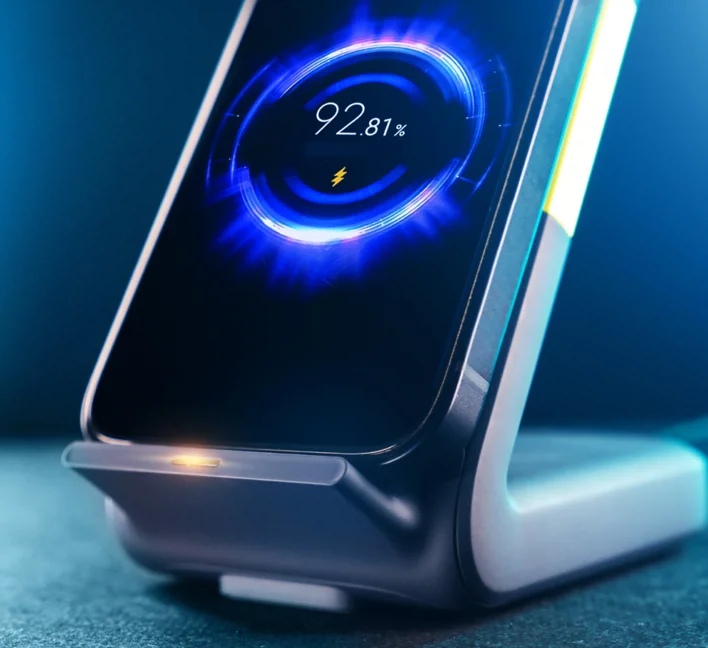
Introduction: Wireless Charging Went From a Party Trick to a Default
A decade ago, "drop your phone on the desk and it just charges" was a stage demo. Today, wireless charging is as expected as Wi-Fi. The standard behind that shift has a name: Qi.
This article follows the technology from the ground up — the physics of magnetic induction, the leap to Qi2, and the arrival of Qi2 25W — then shows how those standards come to life in a real product: our 3-in-1 magnetic wireless charger.
What Is Qi? A Charging Standard the Whole Industry Adopted
Qi is defined by the Wireless Power Consortium (WPC) and first launched in 2010. Its purpose is simple and demanding: make devices and chargers from different brands work together safely, efficiently, and interoperably.
Standards earn trust through scale. Today there are more than 13,000 Qi Certified products on the market, making Qi the global benchmark for wireless charging of mobile devices.
The standard keeps evolving:
Version | Released | Key capability |
|---|---|---|
Qi (original) | 2010 | Established the base spec for inductive wireless charging |
Qi v2.0 | 2023 | Added magnetic alignment for faster 15W charging |
Qi2 25W (Qi v2.2.1) | July 2025 | ~70% more charging power than the prior generation |
In one line: Qi is both a promise of safety and interoperability and the foundation that let the whole industry scale.
Magnetic Induction: The "Basic Science" Behind the Magic
Wireless charging feels like magic, but the WPC puts it plainly — "sometimes it looks like magic, but it's really just basic science."
The mechanism is magnetic induction. A coil inside the charger, driven by an alternating current, creates an alternating magnetic field. A receiving coil inside the device induces a current from that field, transferring energy without wires. The hard parts are the engineering details:
- Whether the two coils can align precisely, and
- Whether the energy can move efficiently, controllably, and safely.
That is exactly why "alignment" became the central pain point of wireless charging — and the engineering problem Qi2 set out to solve.
Qi2: How Magnetic Alignment Changed the Game
Qi2's headline feature is magnetic attachment. Magnets snap the device and charger into perfect alignment, delivering three wins at once:
- Better efficiency — aligned coils mean less wasted energy;
- Faster charging — energy reaches the device more directly;
- Better usability — drop it down and it just works, no fiddling for the "sweet spot."
On top of that, Qi2 25W pushes charging power up by nearly 70%. The WPC's own benchmark: charging a smartphone battery from 0 to 50% in about 30 minutes. For anyone topping up several times a day, that closes most of the gap between wireless and wired fast charging.
Why Certification Matters More Than Specs
Plenty of products look good on a spec sheet. Whether you can trust one comes down to certification.
To earn Qi Certification, a product must pass rigorous safety and interoperability testing in an independent, authorized test lab before it is allowed to carry the Qi or Qi2 mark. In short: only Qi Certified products may display the Qi or Qi2 logo — and that logo is a reassurance that your devices will work exactly as expected.
In a world where one desk now charges a phone, a watch, and earbuds at once, interoperability is the most easily overlooked — and most experience-defining — spec of all.
Beyond Phones: Sustainable and Future-Ready
Qi isn't only about convenience. It's reshaping two bigger things.
Sustainability. Worn-out cables and broken charging ports are two of the most common quality issues with smartphones — and both usually mean a new cable or a new phone. Qi2 devices have no cable to wear out and put no mechanical stress on the charging port, cutting e-waste at the source.
Future-readiness. With magnetic locking, Qi2 opens the door to new form factors such as AR/VR headsets and accessories that snap magnetically to the back of a phone. This is wireless charging evolving into a wireless ecosystem.
From Standard to Product: How We Built Ours
With the standards in view, our V23 3-in-1 Magnetic Wireless Charger makes more sense — every design choice maps back to a technical decision.
Positioning: MagSafe magnetic · touch electric rotation · metal body · 3-in-1 · Qi2 fast charging
1. Magnetic Alignment — the Same Logic as Qi2
The charger supports magnetic charging: bring your phone close and it snaps into alignment automatically. That is the exact principle Qi2 uses to solve alignment — once the coils sit flush, charging gets more efficient and more stable, and everyday use becomes a true "drop and go."
2. Touch Electric Rotation — One Step Beyond a Fixed Stand
On top of magnetic alignment, we added a touch-controlled electric rotation mechanism. No unplugging or repositioning — a light touch changes the angle, turning the charger into both a charging dock and an adjustable desk stand.
3. Three-in-One — Covering the Whole Charging Ecosystem
Just as Qi has expanded from phones to watches, earbuds, and beyond, our product is built 3-in-1: a single unit wirelessly charges a phone, a watch, and earbuds at once.
- Dual-watch version: compatible with Apple and Samsung watches;
- Single-watch version: one-stop wireless charging for phone / watch / earbuds.
One device replaces multiple cables and plugs.
4. Build Quality and Fast Charging
- Materials: metal + ABS for a premium, durable finish;
- Fast charging: Qi2 15W, QC3.0-compatible, 20W total system power;
- Output: 15W output power, 3A output current;
- US plug, ready out of the box.
5. Compliance You Can Verify
Standards ultimately come down to what's provable. This product carries:
- FCC certification and a CE certificate (No. E-P2508192 0933);
- A utility model patent (No. ZL 2024 2 2513164.6);
- Qi standard compatibility with mainstream wireless-charging devices.
These credentials are our commitment to safety and interoperability — beyond the numbers on a spec sheet.
Product Specs at a Glance
Attribute | Specification |
|---|---|
Product | V23 3-in-1 Magnetic Wireless Charger |
SKU / Brand | V23 / TENGPIN |
Max output power | 15W |
Total system power | 20W |
Output current | 3A |
Charging protocol | QC3.0 |
Magnetic | Yes |
Materials | Metal + ABS |
Weight | 385 g |
Compatibility | Qi standard; dual-watch version supports Apple / Samsung watches |
Certification | FCC, CE |
Patent | Utility model patent ZL 2024 2 2513164.6 |
Colors | Black / Silver |
Plug | US |
Package size | 9.5 × 9.5 × 13 cm |
Data note: Specs and credentials are taken from the published product listing. The listing title references "25W," while the spec table shows a 15W max output and 20W total system power; this article uses the spec-table values. Confirm the title's power claim with the supplier before publishing marketing copy.
FAQ (for FAQ schema)
Is Qi the same as Qi2? No. Qi is the original standard (2010). Qi2 (2023) adds magnetic alignment and 15W charging, and Qi2 25W (July 2025) raises power by roughly 70%.
Do I need a Qi-certified charger? Yes — only Qi Certified products may display the Qi/Qi2 logo, which signals that the product passed independent safety and interoperability testing.
How fast is Qi2 25W? WPC cites about 30 minutes to charge a smartphone from 0 to 50%.
Can one charger power a phone, watch, and earbuds? Yes. Our 3-in-1 charger does exactly that, with a dual-watch variant supporting both Apple and Samsung watches.
Conclusion
From Qi's debut in 2010, to Qi2 redefining alignment through magnets in 2023, to Qi2 25W pushing speed further in 2025, wireless charging has followed one clear line: make energy transfer better aligned, more efficient, safer, and more seamless.
A good product is simply that line translated into daily experience: snap-and-charge, touch-to-rotate, one dock for phone, watch, and earbuds — backed by certification and patents. Explain the technology well, and the product sells itself.
Suggested image placements
- After intro — lifestyle shot (phone charging on desk);
- "Qi2" section — magnetic alignment diagram;
- "How We Built Ours" — product hero image + touch-rotation demo;
- End of product section — FCC / CE and patent certificates;
- "Specs at a Glance" — spec graphic.