Oct 12, 2026
How Large-Area Nanoimprint Lithography Scales AR Waveguide Production
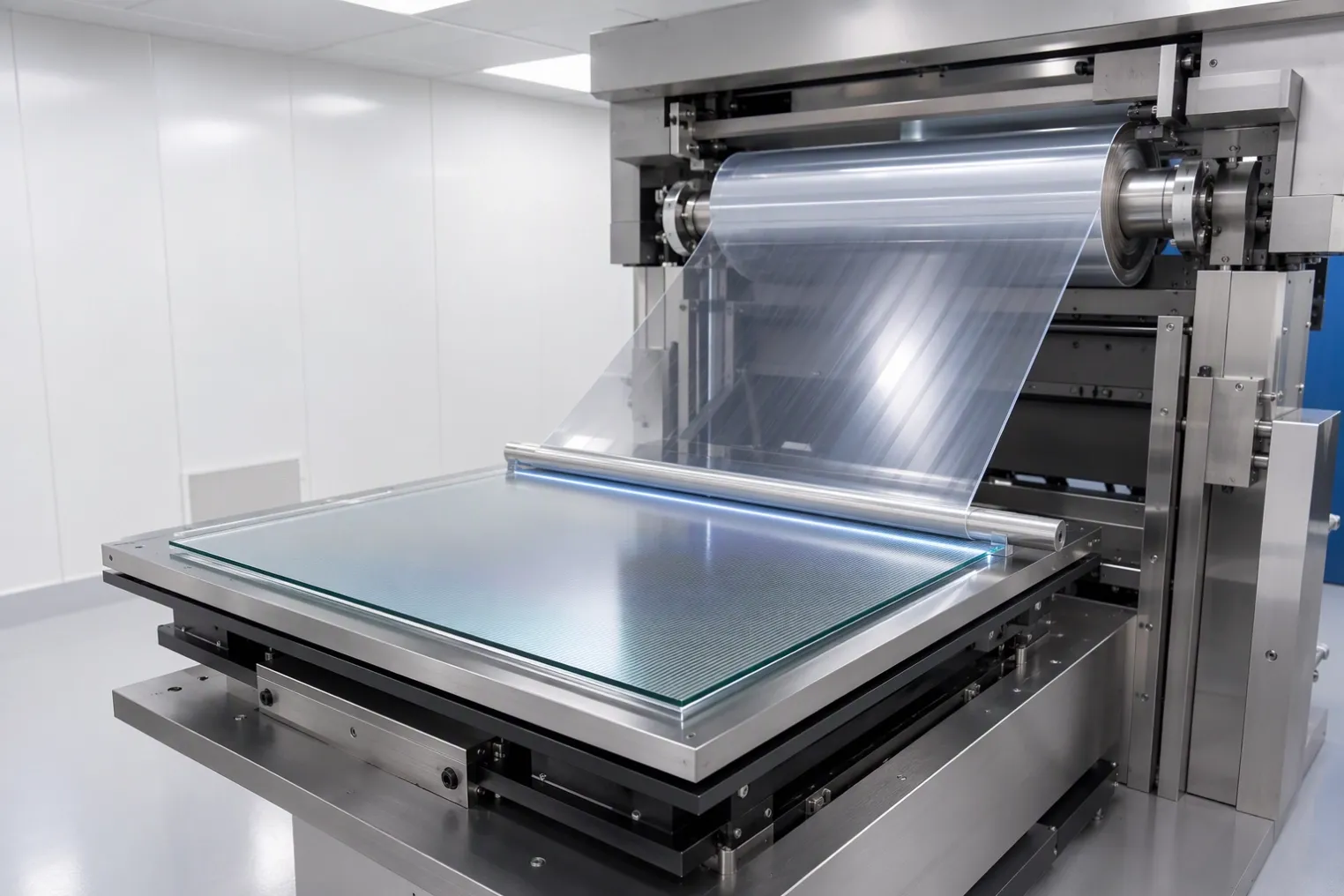
In short: Large-area nanoimprint lithography (NIL) is being applied to produce surface-relief grating (SRG) waveguides in volume on large, high-index glass panels rather than only on wafers. A consortium spanning design, mastering, materials, imprinting, and metrology demonstrated replication on 300 × 300 mm square glass at 1.9 refractive index, producing 270 waveguides in a single imprint pass. The work reports strong grating uniformity and imaging agreement across repeated imprints, while flagging waveguide design, scalability, and reproducibility as open challenges.
What problem does large-area NIL solve for AR waveguides?
High-performance, scalable, and cost-effective optics are a foundational building block for smart-glass hardware. Large-area NIL reproduces nanoscale patterns on substrates larger than standard wafers, which is what makes high-volume SRG waveguide production plausible. The reported work used a coordinated approach across partners responsible for design, mastering, materials, imprinting, and metrology, consistently replicating the intended design across large, high-refractive-index (1.9 RI) square glass substrates with matching 1.9 RI resins.
How is the grating master created?
A high-quality SRG master is fabricated in silicon using electron beam lithography (EBL) followed by dry etching. The design includes a binary pupil expander, output gratings, and a blazed input grating. Using EBL for all SRGs fixes precise grating periods and lateral dimensions and preserves the relative position and rotation between individual gratings, while silicon dry etching maintains structural fidelity and etch-depth precision. After pattern transfer, the master is cleaned and a first-generation submaster is replicated onto glass using Ormostamp.
How many eyepieces come out of one imprint run?
Production replication uses Morphotonics' Roll-to-Plate (R2P) NIL, whose scalability to larger substrates maintains replication fidelity and dimensional stability. The R2P modules allow 270 eyepieces per Gen-5-sized (1100 × 1300 mm) imprint run, with later capacity cited at 480. The demonstration replicated a 30-up sub-master across nine single wafers to produce 270 waveguides in one imprint pass. Flexible stamps keep imprint quality consistent, high-definition-structure (HDS) stamps provide dimensional stability, and the high-index resins supplied by Pixelligent Technologies were chosen for maximum field of view and low waveguide loss.
Which glass properties set the performance ceiling?
SCHOTT RealView wafers of 100 to 300 mm diameter and 0.3 to 1 mm thickness are widely used in NIL manufacturing, offered in refractive indices typically from 1.7 to 2.0 with index-matching resins; larger square and rectangular high-index wafers were developed for volume production. Refractive index and transmission bound field of view and battery life, and reducing thickness raises the number of ray bounces inside the waveguide, degrading image quality. Flatness targets are demanding: total thickness variation (TTV) below 1 µm, local thickness variation (LTV) below 1 µm, and surface roughness under 1 nm to limit scattering. Two routes exist for larger panels: the technical-glass route (overflow fusion or downdraw) gives direct access to thin sheets but struggles with the viscosity and crystallization behaviour of high-index glass, while the optical-glass route cuts and polishes a wider range of high-index glass into wafers, with the maximum strip format setting the largest possible wafer size.
How is replicated waveguide quality measured?
Three complementary methods were used across nine samples — three homogeneity-test and six reproducibility-test waveguides:
- Littrow diffractometer — a stable 405 nm laser on the sample with a machine vision camera, rotary stages for yaw and roll, and an XY stage for area coverage; it measures grating period and relative orientation with picometer and arcsecond accuracy.
- Image-quality tester — a WG-IQ tester with a uniform OptoProjector light engine and OptoEye 2.0 lens projected test patterns through the waveguides, analysing checkerboard contrast and luminescence uniformity.
- Modulation transfer function (MTF) — a pupil-matched setup quantified the system's ability to reproduce fine spatial detail.
Littrow measurements showed track-pitch variation of less than 10 pm inside the outcoupler and expander across 100 consecutive imprints. Contrast and uniformity were reproducible across the nine waveguides, and MTF agreed well for most samples, dipping slightly for only two — both after 100 imprints. Optical design began from a 1D-1D pupil-expansion layout that simplifies manufacturing but limits maximum field of view, then used a parametric optimisation in LightTrans International's VirtualLab Fusion to tune blaze angle, height, and ridge width for the incoupler, expander, and outcoupler across five field-of-view modes.
FAQ
What does Roll-to-Plate nanoimprint lithography contribute here?
It is the replication engine for mass manufacturing. Its scalability to larger substrates maintains fidelity and dimensional stability, and it imprints several waveguides at once, with reusable flexible stamps supporting reproducibility and cost-effectiveness.
What refractive index did the glass substrate and resin use?
Both the large square glass substrates and the high-refractive-index resins were specified at 1.9 RI. This pairing supports a wide field of view while keeping waveguide losses low.
How many eyepieces per imprint run were demonstrated?
The reported figure is 270 eyepieces per Gen-5-sized imprint run, later cited at 480. The demonstration replicated a 30-up sub-master across nine wafers to yield 270 waveguides in one pass.
How small was the grating track-pitch variation across imprints?
Littrow measurements found track-pitch variation below 10 pm inside the outcoupler and expander across 100 consecutive imprints, indicating excellent uniformity in grating period and orientation.
References
- SPIE Photonics Focus, "A leap forward in AR smart glass optics manufacturing," Jan Matthijs ter Meulen and colleagues, January 2024 — https://spie.org/news/photonics-focus/janfeb-2024/optimizing-ar-smart-glass-optics-manufacturing