Oct 12, 2026
Why Glass Waveguides Cannot Scale to Mass-Market AI Glasses
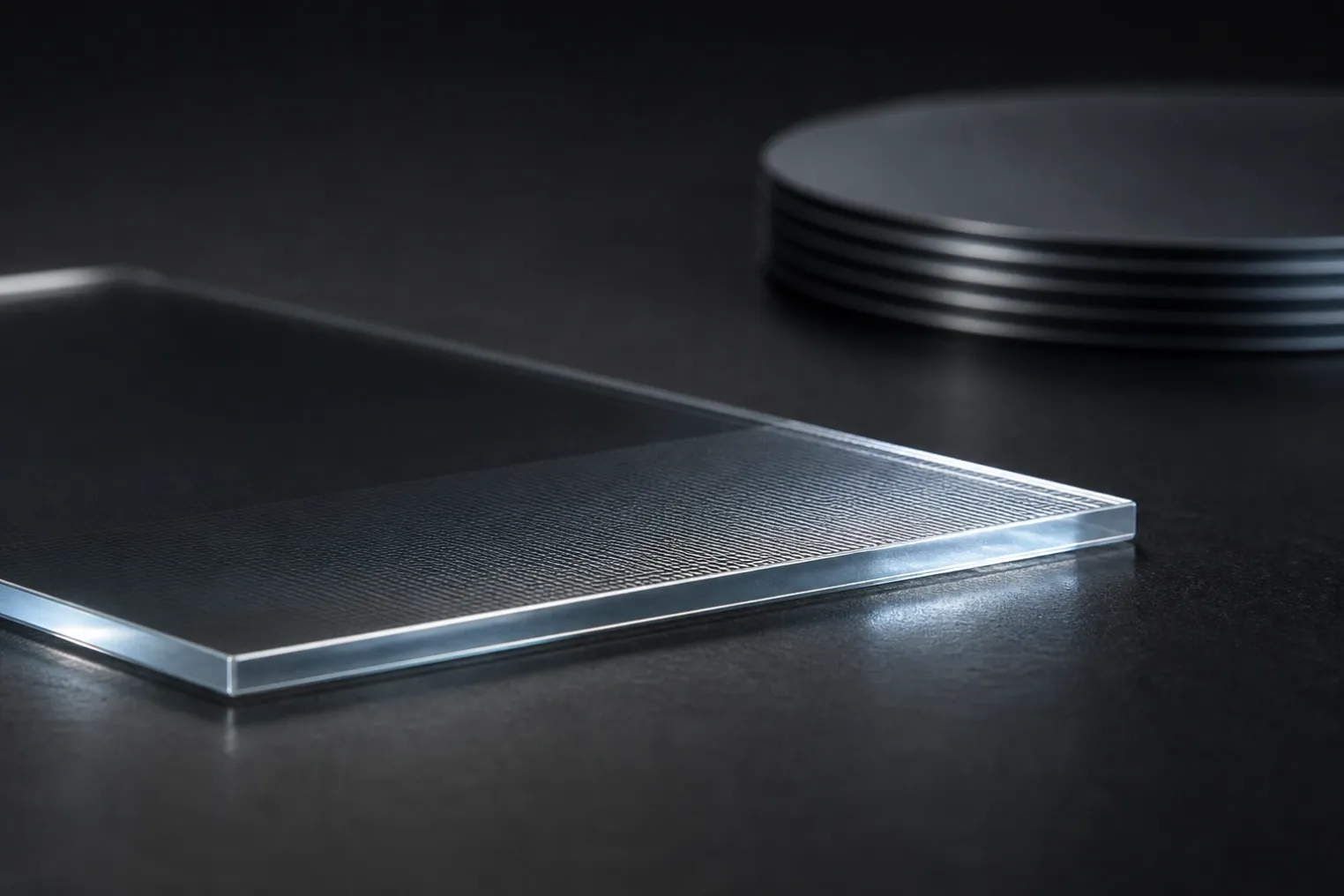
In short: Three structural limits — cost, yield, and compatibility with prescription lenses — keep glass-based waveguide combiners out of mass-market price brackets. A high-index substrate yields only about 20 to 25 dies per 300 mm wafer, geometric designs stack roughly 30 glass pieces, and glass does not match the thermal expansion of polymer ophthalmic lenses. An injection-molded, monolithic polymer reflective waveguide built from two parts in a single step is presented as an alternative that is natively compatible with ophthalmic manufacturing.
Why do glass waveguides carry a hard cost floor?
Both diffractive and geometric glass waveguides sit on a cost floor set by substrate yield. High-index glass wafers produce only around 20 to 25 usable dies from a 300 mm wafer, whereas semiconductor lithography commonly returns yields in the hundreds or thousands per wafer. Because the fixed cost of preparing and processing the substrate is spread over far fewer devices, per-unit optical cost stays high no matter how efficient the downstream process becomes. That gap between optical-substrate economics and semiconductor economics is the root of the scaling problem.
What makes geometric waveguide assemblies yield-limiting?
Geometric designs add a second cost problem. They are assembled from roughly 30 separate pieces of glass. Every additional interface is an opportunity for a defect, and each defect can scrap the whole assembly, so the yield of a 30-piece stack falls faster than that of a simpler element. The result is a flow where component count, not optical design, limits how many good units come off the line.
Why does ophthalmic incompatibility block prescription integration?
Glass waveguides do not match the coefficient of thermal expansion of the polymer lenses used in ordinary prescription eyewear. That mismatch prevents glass combiners from integrating cleanly with ophthalmic lenses, which matters because a very large population needs vision correction — the source cites 2.7 billion people. If AR glasses cannot be delivered with a user's prescription built in, a substantial share of the addressable market is excluded regardless of display quality.
What alternative is proposed?
The proposed route is a monolithic, injection-molded polymer reflective waveguide manufactured from two parts in a single step. Because it is molded from polymer rather than assembled from stacked glass, it is described as natively compatible with ophthalmic manufacturing. The approach was presented by Kayvan Mirza of OPTINVENT S.A. in France, a company that describes itself as a pioneer in AR waveguides since 2007.
Metric | Glass-based (diffractive / geometric) | Monolithic polymer reflective |
|---|---|---|
Dies per 300 mm high-index wafer | ~20–25 | injection-molded, not wafer-limited |
Assembly piece count | up to ~30 glass pieces (geometric) | two parts, one step |
Expansion vs polymer ophthalmic lens | mismatched | compatible |
Field of view | not stated | 50° |
Efficiency | not stated | up to 5,000 nits/lm |
Weight | not stated | ~4 g |
Waveguide cost | ~€200 | ~€50 at moderate volume, toward €10 at scale |
What performance and cost does the polymer route report?
The reported results are 50° field of view, efficiency up to 5,000 nits/lm, a weight of about 4 grams, and fixed-distance focus without the push-pull optics some architectures need to place an image at a comfortable distance. On cost, the waveguide is said to fall from roughly €200 to about €50 at moderate volume, and toward €10 at scale. If those figures hold, the economic case would rest less on a single optical breakthrough than on replacing a wafer-and-assembly process with molding that already exists in the eyewear supply chain.
FAQ
How many dies can a high-index glass wafer yield?
A high-index substrate is reported to yield only about 20 to 25 dies from a 300 mm wafer. Semiconductor lithography, by comparison, yields hundreds or thousands per wafer. That difference is described as a hard cost floor for glass waveguides.
Where does waveguide cost start, and where can it go?
The glass route is quoted at roughly €200 per waveguide. The polymer alternative is reported at about €50 at moderate volume, with a path toward €10 as production scales.
How many people need vision correction?
The source cites 2.7 billion vision-correction users. Their needs are central to the argument, because glass waveguides do not integrate with the polymer lenses used in prescription eyewear.
What field of view does the polymer waveguide demonstration quote?
The reported field of view is 50°, alongside fixed-distance focus without push-pull optics — meaning the image is placed at a set distance rather than adjusted mechanically.
References
- SPIE Photonics West, presentation 14490-36, "Why the waveguide is blocking mass-market AI glasses," Kayvan Mirza, OPTINVENT S.A. (France), 1 February 2027 — https://spie.org/photonics-west/presentation/Why-the-waveguide-is-blocking-mass-market-AI-glasses/14490-36